(Gustave Doré, The Divine Comedy: Inferno, Dante and Virgil leaving the dark wood, 1861)
Before Prometheus seized Zeus’ furtive fire to awaken mankind from their slumbering shade, amidst the fabled lands of Hellas and Anatolia arose the mystifying isle of Menodora. Near the maiden’s waters wandered the magisterial vessel of Adamantios, ramming across her white shores in the Aegean Sea. Here dwelled a nymph who held dominion over her woodland realm, enticing a mariner with the mellow aroma of her plums to bind him under a spell. Whilst Adamantios delved ever deeper into the boughs of Menodora, she stretched her branches to and fro, wrapping him beneath her limbs. She then beheld the stout craft of his ship as he glimpsed the bewildering beauty of her magical domain. Thereupon, a spirit became smitten by the form when Menodora slept with Adamantios and conceived Diodorus.
After the moon’s fading and the sun’s rising, the father departed when he was mustered to resume his post. Without hesitation, he chose to abandon his beloved and child, sailing away with a promise to return when his task had been fulfilled. Alone, the mother sprang her seed, nurturing him within her woodland realm. She entwined her branches to cloud him with the gloom of Nyx and the paleness of Selene, bloating Helios’ chariot from fetching the light. Diodorus became shunned from the eternal flame that eclipsed every year, casting a shadow over the rotation of Adamantios’ sundial. Amidst the mystical isle of Menodora, ensnaring vines stretched to the east and west, where her son was confined to the borders of her magical domain under duress by the zealous nature of his mother.
Persistently, Diodorus wailed to be quelled by the breast of Menodora, latching onto her bosom to hide from mankind in seclusion. Amidst bountiful trees, the child was fenced from the seas, towered from the heavens, and prohibited from leaving his mother’s sight. Whilst he grew steadfast in stature, Menodora was reminded of her beloved and became haunted by the recollection of his departure. In his father’s absence, Diodorus lacked form and was cast from his mother’s spirit. She leashed him with slithering vines and forced him to remain at her side, fearful he’d forsake her as Adamantios had. Every day, she gathered the harvest and gifted the labor to him, robbing her child of freely snatching nourishment on his own. Everything Diodorus demanded, Menodora provided by merely mumbling and pointing at what he desired. Infancy bloomed into childhood and matured into adolescence, with the feeble boy now grown into a stout man who had been shielded from all he feared, incapable of uttering the tongue of mankind and picking himself up to tread in their footsteps. In time, the son became maimed whilst his nurturer spoiled him when she ceaselessly recited: “Come mine dear Diodorus and listen to thy mother, thou shall never be compelled to stretch thy feet or declare with thy tongue, for mine woodland realm will deliver thou with every fruit and need, as thy requests shall be satisfied with great haste and heed.”
Thence, Adamantios returned from his perilous journey to her ragged shores, longing to amend for his absence. After forsaking his duty, he sought the embrace of Menodora, haunted by a guilty conscience. However, when the father delved into her woodland realm, he became horrified by the sight of his son still clasped in the belly of the mother. There, Diodorus wriggled and whined, waiting to receive whatever was within Menodora’s grasp. In a flicker, Adamantios fumed with a fit of fury, flashing his saber to cut through the veins that wrapped his son whilst he gazed in revulsion at a man subjected to his mother’s breast. The boy collapsed at his father’s feet as he seized him to raise Diodorus into manhood. For the last time, the nymph and the mariner beheld one another as his craft repulsed her, and he became terrified of her charm. In piercing grief, Menodora wailed the loss of her son, struggling to catch Adamantios with the threads of her net. Desperately, she clung to her child’s numb feet from the tree’s brittle branches, but his father dragged him with the ship’s chains away from his mother in that cursed isle. Thereupon, the spirit split from the form when Adamantios robbed Diodorus of Menodora.
They set off aboard the father’s vessel, where his son tirelessly labored to earn rations of food and stood on his feet to maintain an admirable reputation. As the waves crashed to and fro, he became sick and barely fulfilled his tasks, failing to steer the ship. Once more, Adamantios’ temper was incited, and Diodorus turned his bitterness against him as their rivalry to claim mastery originated. A contemptuous struggle ensued between a father’s absent presence and his son’s boyish witlessness. In that ship, Diodorus toiled under the whip of Adamantios until he could go on no more, longing for the lodging of his mother. He failed to grasp the aptitude of speech and every errand assigned, only learning to imitate the ferocity of his father. In time, the son became maimed whilst his master flogged him when he ceaselessly shouted: “Come mine meek Diodorus and listen to thy father, thou must endeavor to gain sustenance and station, for mine vessel will test thy body and break thy soul, as thine every deed accomplished shall be rewarded with utter haste and heed!”
After arduous trials, Diodorus learned to speak the tongue of mankind and tread in their footsteps, but his deeds were driven by spite, craving to surpass Adamantios. When the boy mustered the mettle of a mariner, he unleashed his newfound potency to strike down his father. Immediately, Diodorus seized the saber and smote him, steering the ship back to the isle of his mother. Upon returning, he rammed the shattered vessel into Menodora’s colorless shores, where he burned Adamantios’ craft to sever his road to mankind. From afar, a mother witnessed the wickedness of her child, who slew his father in retribution. When he sought refuge, she disregarded his deed, wrapping him within the haven of her bosom, where he would never age in her woodland realm. Thus, Menodora’s spirit rotted to mold, and Adamantios’ form flickered into ashes, as their boy, who never grew, drowned amidst the waves of the sea, swallowing Diodorus in his youth.
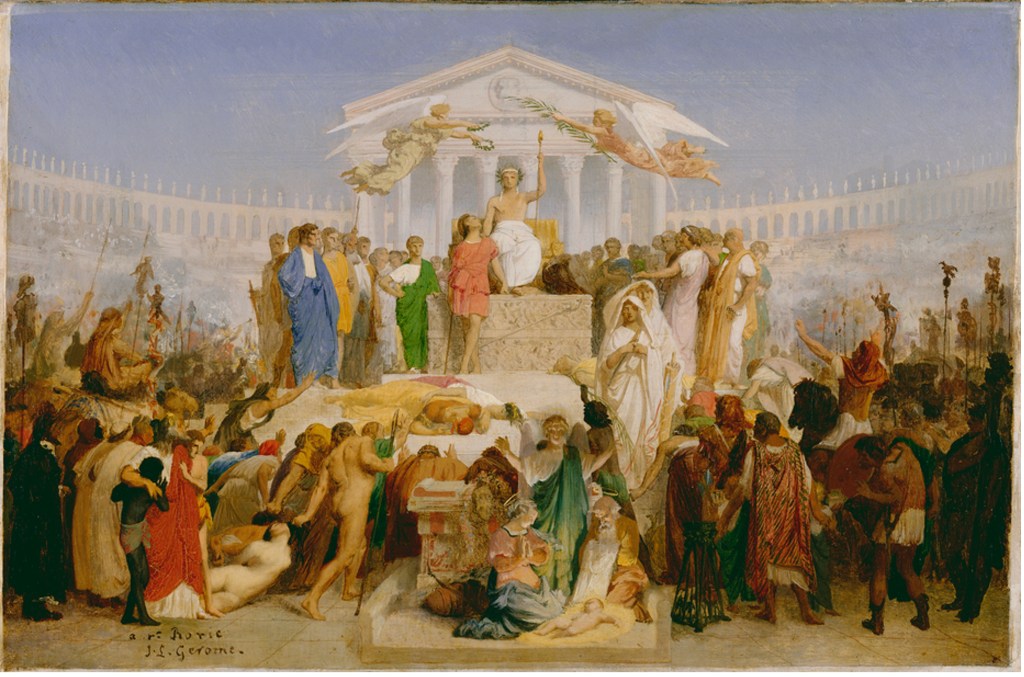
(Jean-Léon Gérôme, The Age of Augustus, the Birth of Christ, 1852-1854)
If you’ve browsed a book or two recently, you’ve likely noticed a curious detail whenever there’s a historical date. Instead of the usual BC and AD after the year, it’s been changed to BCE and CE. But what are these ‘new’ terminologies? And why are they replacing a ‘dated’ lexicon? Lately, there has been a tendency for institutions to ‘modernize’ fields such as history by replacing BC (Before Christ) and AD (Anno Domini) with a socially ‘inclusive’ BCE (Before The Common Era) and CE (The Common Era). Historians continue to challenge long-held perceptions, with their discoveries constantly shifting the academic field’s understanding of the ancient world. They’re responsible for reconstructing historical narratives that faithfully preserve the past, despite personal biases. However, texts and articles have currently opted to separate historical periods into the ‘enlightened’ BCE and CE, over the ‘traditional’ BC and AD.
Why has academia substituted Christ with the Common Era? Have scholars found a revolutionary method to measure the Earth’s Orbit? Or could this sudden revision be a modernist attempt to erase Christianity from History? Ironically, the Birth of Christ divides both periods, even though they use different terminologies. What is the point of changing the lexicon if the same historical event separates them? These questions can be answered by investigating the remarkable innovations of the Ancient Romans and Medieval Priests who designed the Julian and Gregorian Calendars, along with exploring the origins of BC and AD to determine whether BCE and CE are justified in removing this religious language.
In 49 BC, the die was cast, and Julius Caesar Crossed the Rubicon, dragging the Roman Republic into a Civil War that would rout his rivals and usher in his rise as Dictator of Rome. During his short-lived reign, Pliny the Elder, a Roman author, narrates in his ‘Natural History’ (77 AD) that Caesar’s reforms were aimed at legitimizing his ascension, working with Sosigenes, a Greek astronomer who advised him to amend the Old Roman Calendar. While studying in the Library of Alexandria, Sosigenes deduced that the Ancient Egyptians had accurately recorded the days of the year since the Old Kingdom. Due to the cyclical flooding of the Nile River Valley, they calculated that there were an estimated 365 days a year. Once Caesar landed in Ptolemaic Egypt around 48 BC, he met Sosigenes while having an affair with Cleopatra VII. They reformed the Lunar Calendar, based on the moon’s phases, into a Solar Calendar, aligned with the Earth’s Orbit around the sun. This was the foundation for the Modern-Day Calendar, with 365.25 days a year and a leap year of 366 days every four years to stay in sync with the Earth’s Orbit.
Macrobius, a Roman writer, recounts in ‘Saturnalia’ (431 AD) how the Old Roman Calendar was used one last time around 46 BC, during a transitional phase known as ‘The Year of Confusion.’ A momentary extension of 445 days was made for the year to adjust from a Lunar to a Solar Calendar. Then, Caesar and Sosigenes officially introduced the Julian Calendar in 45 BC. An additional 10 days and 2 months were added to the original 355 days and 10 months per year. Suddenly, the Senate conspired against their Dictator, assassinating him on March 15, 44 BC. But their coup failed, and posthumously deified Caesar under the title of ‘Divus Iulius’ (Divine Julius). And to honor his birthday, the month of ‘Quintilis’ (Fifth) was renamed ‘Julius’ (July). Amidst the chaos, Octavian triumphed as Caesar’s heir, soundly defeating the Dictator’s murderers and allies to become Caesar Augustus, the First Roman Emperor. He authorized adjustments to the Julian Calendar between 9 and 8 BC, legitimizing his predecessor’s labor. Similarly, the Senate honored the month of ‘Sextilis’ (Sixth) to ‘Augustus’ (August). Nevertheless, a slight miscalculation led to an inaccuracy in the Julian Calendar, causing a gradual drift from 45 BC to 1582 AD.
Since the Republic, Roman historians such as Livy based the dating system in ‘Ad Urbe Condita’ (27-9 BC) around whichever two men held office as consuls in the Senate, naming the year after them. Thereafter, regnal years gained popularity, bearing the name of the current Emperor. Alternatively, the calendar was measured with ‘Ad Urbe Condita’ (From the Founding of the City), counting years since Romulus founded Rome in 753 BC. During Emperor Diocletian’s Tetrarchy (293-305 AD), the reign of the four emperors was known as the Diocletian Era, Latin for “Anno Diocletiani” (The Year of Diocletian). These years were characterized by the ‘Diocletianic Persecution’ of Christians, with the Coptic Church of Alexandria calling it instead the ‘Era of Martyrs.’ Once Diocletian stepped down, Constantine emerged victorious from the Civil Wars of the Tetrarchy (306-324 AD), reunifying a fractured Roman Empire. Upon the eve of Battle at the Milvian Bridge, he received a vision of Christ’s Cross. And in the Lord’s Sign, Emperor Constantine conquered, legalizing Christianity. Furthermore, the Edict of Milan (313 AD) granted religious freedom to Christians, while the Council of Nicaea (325 AD) affirmed the Divinity of Christ, thereby ending centuries of brutal oppression.
Afterward, Dionysius Exiguus of Alexandria, a translator and astronomer, used the Julian Calendar in the 6th century as a framework to create a new system for numbering years. In 525 AD, the Christian Monk published his ‘Liber de Paschate Praefatio’ (Book on Easter Reckoning), introducing the concept of a Christian Era based around the Incarnation of Jesus Christ. This replaced the heretical ‘Era of Martyrs’ with ‘Anno Domini nostri Jesu Christi’ (In the Year of Our Lord Jesus Christ). Later on, Saint Bede, an English Monk, wrote the ‘Ecclesiastical History of the People of England’ in 731 AD. The medieval manuscript narrated events from Roman to Anglo-Saxon Britain, tracing the chronicles of the Early Church. Essentially, this historian and theologian documented Britain’s history with the popularized use of ‘Ante Christi natum’ (Before the Birth of Christ). Through these Monks, the consular years, regnal years, and ‘Ad Urbe Condita’ were rechristened to record historical periods before and after the Incarnation of ‘Jesu Christi.’
Over the centuries, Christian Festivals fell out of season due to a miscalculation traced back to Sosigenes and Caesar, who erroneously assumed that the solar year had 365.25 days. In reality, Earth’s Orbit around the sun takes 365.2564 days, which may seem like a minor slip-up if it weren’t for the millennium that had come and gone, misaligning the seasons. The Old Julian Calendar’s seasonal dates had regressed by roughly a day every century. Next, Aloysius Lilius, an Italian astronomer, chronologist, and philosopher, proposed in 1577 a reformation with his ‘Compendium novae rationis restituendi kalendarium’ (Compendium of a New Plan for the Restitution of the Calendar). He counseled that the ‘Leap Year Rule’ had to be modified to align the seasons with the solar year precisely. Previously, a leap year added an extra day to the Old Julian Calendar every four years to account for the quarter of a day that had accumulated over the last three years. His proposition revised the principle that every year divisible by four was considered a leap year. Instead, Aloysius Lilius engineered a dating system in which century years ending in ‘00’ would not be considered leap years unless they were divisible by 400. For example, 800 AD would be a leap year, but centuries like 500-700 AD could not qualify. These modifications ensured that the New Calendar would remain synchronized alongside the seasons, with 97 leap years every 400 years.
All of this previous research prompted Pope Gregory XIII to announce the papal bull ‘Inter gravissimas’ (In the gravest concerns) on February 24, 1582, calling for the reformation of the Old Julian Calendar. Back in 1579, Christopher Clavius, a German mathematician and astronomer, began implementing this commission with the Gregorian Calendar. He built upon Aloysius Lilius’ work and refined the ‘Leap Year Rule,’ discovering a discrepancy of 10 days caused by the Previous Calendar’s gradual drift. To properly align the New Calendar with the Solar Year, Pope Gregory XIII decreed that, after October 5th, 1582, the following day would be the 15th. Each contribution was made by Jesuit Priests who addressed the realignment of the calendar while honoring the legacy of their ancestors, preserving the months of July and August, alongside the traditional use of BC and AD.
This raises the central question: Why has academia substituted the terminology of BC and AD with BCE and CE, if they’re both divided by the Birth of Christ? Have scholars developed innovative measurements for the Earth’s Orbit? Or is the postmodernist lens deconstructing ancient traditions by rephrasing the cultural memory of the past? Basically, BCE and CE stand for ‘Before the Common Era’ and ‘Common Era,’ coining a new lexicon that removes Christianity from History through a secular approach to separate these periods. The intent is to adopt a non-biased stance when conducting scholarly research, setting aside a dating system that is associated with a religious figure (Jesus Christ) to maintain academic neutrality. However, this is done at the expense of taking away recognition from Christian Monks and Jesuit Priests who wrote historical records and accurately calculated the Earth’s Orbit. If the argument is about objectivity in the field, why do July and August still have the names of the Caesars? Wouldn’t their persistent use expose political favoritism with the Roman Senate, a Dictator, or an Emperor? This is, of course, a ludicrous statement, since Rome fell in 476 AD, more than 1,500 years ago, and its governmental institutions have lost all relevance. Nevertheless, the names of Julius and Augustus have remained intact for these months, without any controversy, recognizing their roles in reforming the Julian Calendar.
On another note, there’s a case to be made for the pagan origins of the days of the week that trace back to Greco-Roman and Norse-Germanic Mythology. In Dio Cassius’ ‘Historia Romana’ (233 AD), the historian discusses the Roman Planetary Week, with each day named after a celestial body that represented a god. Sunday and Monday were ‘Sol’ (Sun) and ‘Luna’ (Moon), while Tuesday, Wednesday, Thursday, Friday, and Saturday were Mars, Mercury, Jupiter, Venus, and Saturn. But these were replaced by the Norse-Germanic Peoples, with Snorri’s ‘Edda’ (1220 AD) narrating a body of myths and legends that includes names of the week, which were changed to reflect their traditional beliefs. Thus, ‘Sól’s day’ and ‘Mani’s day’ became Sunday and Monday, while Tyr’s day, Wotan’s (Odin’s) day, Thor’s day, and Freyja’s day became Tuesday, Wednesday, Thursday, and Friday. All save one Roman god lingered on as Saturn’s day (Saturday). Although academia has replaced BC and AD to preserve ‘academic integrity’ on the issue of Jesus Christ, none of these pagan gods have been scrutinized, posing questions about whether there’s a double standard in a dating system that also, ironically, uses religious figures for the days of the week.
The Legacy of the Ancient Romans and Medieval Priests still lives on in the Modern-Day Calendar, with their contributions ranging from Sosigenes’ designs, Caesar’s and Augustus’ implementations, to Saint Dionysius’ and Bede’s transcriptions, alongside Aloysius Lilius’ and Christopher Clavius’ calculations that cemented the traditional use of BC and AD. Unlike the achievements mentioned above, no subsequent scholar has proposed a ‘modern’ revision of the Calendar that offers a groundbreaking discovery. Regrettably, the historical figure of Jesus Christ has been subjected to constant critical examination. Meanwhile, July and August continue to honor the Ancient Romans, while the days of the week sustain the cultural memory of the Old Norse gods. Throughout antiquity, individuals such as Abraham, Alexander, and Augustus left their mark on history, with the Patriarchal Age, the Hellenistic Period, and the Augustan Age, which were named after them due to their defining roles. Undoubtedly, Jesus Christ had a profound cultural impact on the world with his Birth, Preachings, Miracles, Crucifixion, and Resurrection. The Messiah’s Disciples spread the Gospel that Converted the Roman World, stretching across Europe, Africa, and Asia, from Paganism to Christianity. His Teachings shaped Western Civilization, influencing its history, philosophy, laws, values, and art. Both the Ancient Romans and Medieval Priests merit equal recognition for their achievements in preserving historical accounts and constructing the Modern-Day Calendar. They composed the Julian and Gregorian Calendars around a dating system that represented their Faith in Christ with ‘Ante Christi natum’ and ‘Anno Domini nostri Jesu Christi’ through the fields of astronomy, mathematics, theology, and history. Ultimately, the issue of whether BCE and CE are justified in replacing this religious language can be answered with a simple question. What pivotal event divides BCE and CE? Nothing less than the Incarnation of the Lord ‘Jesu Christi.’






 The Western Voyager