(Theatrical Poster: The Odyssey, Christopher Nolan, 2026)
Part I: The Death of Homeric Heroism
Tell me, oh muse, of a complicated man… or was he of many ways, twists, and turns? If you’ve been to the cinema lately, Christopher Nolan’s The Odyssey (2026) is all the talk. Throughout the film, Odysseus is portrayed as a difficult and distressed man who is not only burdened by Troy’s Ghost, but also by his desire to be reunited with his wife and son in Ithaca. This most recent adaptation has left audiences wondering which translation he consulted to bring Homer’s Epic Poem to the big screen. Furthermore, it’s relevant to ask whether Nolan’s The Odyssey has faithfully ‘adapted’ (translated) the eponymous hero as a cunning and prideful warrior bound by the Bronze Age’s Codes and Homeric World’s Values, who uses his wits to survive a humbling journey back home. Or has Odysseus been fundamentally altered by Post-Modernists to fit the fears and anxieties of the 21st century, departing from classical ‘imitatio’ (imitation) to instead ‘deconstruct’ him as a complicated and traumatized man?
(Book Cover: The Odyssey, Emily Wilson, 2017)
In interviews, Nolan (Director and Screenwriter) has shared how he relied on Emily Wilson’s (Classicist) most recent translation of The Odyssey (2017). This prompted him to adapt the story of a murderer, thief, and liar… or was he a heroic warrior, a master of trickery, and deception? Undoubtedly, Odysseus has endured some modifications between Homer, Wilson, and Nolan. His character traits have been profoundly redefined to present readers and spectators alike with a different type of hero, whose Ancient Greek Codes and Values don’t adhere to the ‘modern’ world. These changes have caused concern for academics, who ponder whether this complicated and traumatized man bears any resemblance to the once cunning and prideful warrior. What has been lost in translation between Homer, Wilson, and Nolan? Should artists impose their preconceived worldview on an ancient text’s cultural and historical background? How has Odysseus been reconfigured from a Heroic Danaan Warrior, defined by his wits and arrogance, into a Troubled Greek Veteran, who is reimagined as complicated and traumatized?
(Papyrus Fragment with lines from Homer’s The Odyssey, c. 285-250 BC)
For millennia, classicists have rigorously translated Homer’s Epic Poem, grappling with its philological, mythological, cultural, and historical elements. Any authentic translation by a skilled academic can be measured by its ability to represent a good rendition of Ancient Greek in, for example, English. This means respecting the author’s intent and vocabulary while reconstructing them so they may rhyme and ring well in a new language. When a translator instead forces one onto the other to fit a specific terminology or by imposing a ‘modern’ worldview on an ancient text, then the original story becomes lost in translation. Although The Odyssey has been incorporated into a plethora of pop-culture ‘adaptations’, these fall rather into retellings, which don’t aim to be accurate to the source material, and instead brand themselves as a reinvention. Nevertheless, Wilson’s The Odyssey has been circulated as a faithful translation of Homer’s Epic Poem, while deconstructing Odysseus by imposing Post-Modernist Codes and Values on an Ancient Greek Warrior from the Bronze Age, which completely departs from Homeric Heroism.
(Book Cover: The Odyssey, Robert Fagles, 2006)
One of the most prevalent examples of Wilson’s tricky translation is the deviation from Homeric Epithets, where the eponymous hero, who is frequently credited with the quality of ‘πολῠ́τροπος’/polŭ́tropos, instead is a ‘complicated’ man. Meanwhile, seasoned translators such as Robert Fitzgerald, Robert Fagles, and Richmond Lattimore have translated it as ‘man of many ways/twists/turns.’
If you consult a Greek Lexicon or Dictionary, it further validates this translation, revealing that ‘πολῠ́τροπος’/polŭ́tropos is a compound word made up of the adjective: ‘πολῠ́ς’/polŭ́s (many) and the noun: ‘τρόπος’/trópos (turn/way). Why is this seemingly trivial description such a significant change in Odysseus’ characterization?
When combining ‘πολῠ́ς’/polŭ́s (many) and ‘τρόπος’/trópos (turn/way) with the cultural and historical context of the Bronze Age, it is evident that Homer was portraying his eponymous hero with the expected behavior of an Ancient Danaan Warrior. As such, he is bound to the Codes and Values of Homeric ‘κλέος’/kleos, yearning for the search of ‘fame and glory’ throughout the Epic Poem.
(The Eleusis Amphora, Polyphemos Painter, c. 638 BC)
Odysseus’s strategic cunning was his most important attribute, which allowed him to use his ‘μῆτις’/mêtis (skill/counsel) and engineer his way out of hardships, surviving the Trojan War and the Mediterranean Journey to return home. This is exemplified when he comes up with the ingenious idea of building the Trojan Horse, baiting the City of Troy into accepting it as an offering to the gods. Moreover, when the eponymous hero blinds Polyphemus, the Cyclops asks who has inflicted this wound, to which Odysseus responds that ‘Nobody’ did it. This results in a comedic and clever response since the poor creature repeats this to his family, as they believe him to have lost his mind. But ultimately, the eponymous hero’s pride gets the better of him, as he then rectifies that it was ‘Odysseus’ who stabbed him, which results in Polyphemus imploring Poseidon, his father, to curse his voyage. When Wilson chooses to translate ‘πολῠ́τροπος’/polŭ́tropos to ‘complicated,’ the Homeric Epithet carries a negative connotation and psychological baggage. What should read as an Ancient Danaan Warrior, whose strategic cunning is worthy of praise, instead ends up lost in translation, where there is now a moral judgment that wasn’t present in Homer’s Epic Poem.
(Giovanni Domenico Tiepolo, The Procession of the Trojan Horse into Troy, 1760)
Furthermore, the Fall of Troy is described by Homer as: ‘αἰνότατος πόλεμος’/ainótătos pólemos, which has a dual meaning in Ancient Greek. The superlative adjective ‘αἰνότατος’/ainótătos derives from ‘αἰνός’/ainós, which encompasses the event as ‘awe-inspiring’ and ‘dreadful,’ while the noun ‘πόλεμος’/pólemos refers to the war itself. A traditional philologist could translate ‘αἰνότατος πόλεμος’/ainótătos pólemos as an ‘awe-inspiring war.’ This could easily lead to the assumption that the Sack of Troy is to be revered, but instead, the complex phrase stresses both the wonder of the Argive Warriors, who perform mighty deeds, and the terror of the Trojan War, which has claimed countless lives. After 10 years in Troy, Odysseus’ pride shines through with his strategic cunning as ‘πολῠ́τροπος’/polŭ́tropos, earning him the reputation as a ‘man of many ways/twists/turns’ because he comes up with the resourceful and deceitful ruse of the Trojan Horse. In this way, Homer exalts his skill through poetic praise, while simultaneously reflecting on the tragic price it demands. However, Wilson has translated ‘αἰνότατος πόλεμος’/ainótătos pólemos as ‘dreadful violence’, which confines the Siege of Troy to a despicable event, removing its intricacy to instead simplify the Ancient Greek, forgoing the Homeric Heroism found in the eponymous hero and the Trojan War. Therefore, Wilson deprives Homer’s Odysseus of his ‘μῆτις’/mêtis (skill/counsel) by transforming him into a ‘complicated’ man instead of a ‘cunning’ warrior, where he is subjected to a moral judgment since the conflict is stripped of its wonder, only to be filled with terror, replacing his heroic virtues that allowed him to learn of ‘νόστος’/nostos (homecoming) with a psychological burden fit for the 21st century.
Part II: The Erasure of Mycenaean Antiquity
(Exhibition: The Art of Armor in Ancient Greece, Reconstructed Mycenaean Armor from the Late Bronze Age, Dimitrios Katsikis, 2010-2020)
As a whole, Wilson’s translation of The Odyssey achieves a commendable degree of fidelity by employing iambic pentameter as an equivalent of Homer’s dactylic hexameter, with five-beat lines of unstressed and stressed syllables. But this is done at the expense of compressing Homeric Epithets and Phrases, forfeiting their complexity while projecting a ‘modern’ worldview. Odysseus’ narrative role and character traits are reimagined with the fears and anxieties of the 21st century, which in turn further departs from Homer’s Epic Poem in Nolan’s adaptation. Because the eponymous hero is now a complicated and traumatized man, the setting, themes, and tones of this perilous journey must reflect this psychological shift. Instead of recreating the Colorful Palaces and Armor of the Bronze Age in Mycenaean Greece, the film has opted for a ‘Medieval Viking’ Aesthetic. The once vibrant golds and purples have been replaced with dull and dark tints, where characters wear tan costumes, the scenery is pitch black, and the world is morally grey.
(The Odyssey, Christopher Nolan, 2026)
Despite that, Homer’s The Odyssey is a Mythological Story; it does occur within a Cultural and Historical Background of Mycenaean Civilization and the Trojan War. Consequently, it’s puzzling when Nolan, who’s famed for his practical effects and ‘historical realism’ in previous projects (Dunkirk and Oppenheimer), decides to board Odysseus’ crew on a Nordic ‘Drakkar.’ This longship from the Medieval Period was specifically built for long sea voyages and coastal raids during the Viking Age. Accordingly, it replaces the Mycenaean ‘Penteconter’ from Antiquity, which represented a unique maritime tradition of naval warfare and trade routes. Aside from practical reasons, the choice not only conveys Nolan’s deconstructive adaptation of the Bronze Age, which was directly transferred into the visual medium from Wilson’s translation of a difficult and distressed man, but it also exposes Hollywood’s overused trope of the ‘Dark Middle Ages.’
(Book Illustration: The Legend of Odysseus, Ancient Greek Penteconter, Peter Connolly, 1986)
Even further, the film sets out to homogenize the Ancestry and Ethnicity of the Ancient Mycenaean World, relegating the Greek People out of their art, music, literature, and oral tradition. Alongside, it also globalizes the Epic Poem with ‘modern’ vocabulary, producing, for example, jarring conversations such as when Odysseus and Penelope directly mention the Bronze Age Collapse and the Sea Peoples. Most strikingly, the eponymous hero confesses that the Trojan Horse was a wicked crime that caused the downfall of civilization. Regrettably, their interaction reads as a poor attempt to ground this mythical story in ‘historical realism’ by employing terms that wouldn’t be coined until the 19th century by academics. The equivalent would be if a European Knight said in 1453: “Thus falls the Byzantine Empire and the Medieval Period has concluded.” Such an incongruous statement wouldn’t make any sense because how could this individual know he is in the Middle Ages and refer to Rome’s Collapse in the East by terminology that wasn’t invented until the 15th and 16th centuries?
(The Odyssey, Christopher Nolan, 2026)
Part III: The Demystification of Greek Mythology
(The Odyssey, Christopher Nolan, 2026)
In the film, Odysseus’ deconstruction affects his spiritual link with the gods, where the Greek Pantheon is largely absent aside from Athena. Nevertheless, she is relegated to a hallucination of the eponymous hero, caused by his Post-Traumatic Stress Disorder (PTSD). Since Wilson has translated a traumatized man, Nolan subsequently adapted Odysseus’ psychological burden, instead of a prideful warrior who must be humbled by the heavens above. This deprives the Trojan War of anything ‘awe-inspiring,’ since there are no heroic deeds, leaving only a ‘dreadful violence’ that plunged civilization into darkness. Both Wilson and Nolan impose a moral judgment on the eponymous hero, downplaying his strategic cunning to twist him into a murderer, thief, and liar who doesn’t confront divine intervention to find his way home.
(Athena appearing to Odysseus to reveal the Island of Ithaca, Giuseppe Bottani, 1775)
Successively, Zeus and Poseidon lose their agency, while the goddess of wisdom serves only as an instrument of his broken state. The Ancient Greek World is robbed of its mystical wonder and grandeur, leaving only the horrors of the Trojan War and Mythical Monsters. Since Odysseus is no longer a man of many ways, twists, and turns, the film substitutes Homer’s Heroic Danaan Warrior with a Troubled Greek Veteran. A stark difference is that, in the film, the eponymous hero willingly consumes the Lotus Fruit offered by Calypso since he is fraught with personal remorse, whereas in the Epic Poem, his longing to return home and remember his family saves him, refusing the Lotus-Eaters. By dispossessing him of his wits and arrogance, he doesn’t need any heavenly assistance to be freed from Calypso because he is already drowning in a guilty conscience out of his own volition. Both Odysseus and Telemachus have to fend for themselves because Athena’s celestial guidance is nonexistent. If the goddess of wisdom is reduced to a hallucination of Odysseus’ PTSD and isn’t present in Telemachus’ coming of age, then she cannot help them achieve their arcs to either learn the meaning of ‘νόστος’/nostos (homecoming) or grow into a man. As a whole, Homeric Destiny is lost in translation, as neither father nor son has spiritual support; instead, one carries psychological baggage caused by a ‘dreadful violence’ that never fully healed, while the other is trapped in a state of infancy and never matures.
(The Odyssey, Christopher Nolan, 2026)
Despite all of these departures from Homeric Heroism, Mycenaean Antiquity, and Greek Mythology, Nolan’s The Odyssey does have its moments of cinematic brilliance. Matt Damon as Odysseus and Anne Hathaway as Penelope are standouts that encompass the story’s emotional heart, which pays off in the resolution. Here, there’s close fidelity to the source material, as the central theme of ‘νόστος’/nostos (homecoming) is compellingly established to set up proper expectations of his eventual return. When the eponymous hero finally gets back to Ithaca, the film delivers an exhilarating sequence in which the momentum builds from his arrival in disguise as a beggar until he wins the trial, revealing himself to the suitors and defeating them to reclaim his homeland. Notably, scenes such as the encounters with the Cyclops and Circe are skilfully executed, with a visual spectacle of sheer terror. All of these are further elevated by Ludwig Göransson’s moving score, incorporating Ancient Greek Aulos and Lyres, which were specifically reconstructed to match their Bronze Age Designs. Throughout the journey, Nolan preserves Odysseus’ lesson, where he learns the meaning of ‘νόστος’/nostos (homecoming), but loses in his ‘adaptation’ (translation) the man of many ways, twists, and turns, leaving audiences with a Troubled Greek Veteran who is in a broken state from beginning to end.
(Theatrical Poster: The Odyssey, Christopher Nolan, 2026)
Altogether, Homer’s Odysseus has been deprived of his heroic attributes, succumbing to a guilty conscience because he devised the Trojan Horse, which should accentuate his strategic cunning but instead exposes his wicked crime. Both Wilson’s translation and Nolan’s adaptation redefine the eponymous hero by projecting their fears and anxieties into The Odyssey. This results in the Death of Homeric Heroism, the Erasure of Mycenaean Antiquity, and the Demystification of Greek Mythology, imposing in its stead a moral judgment and psychological burden from the 21st century. Instead of engaging in an authentic dialogue with Homer’s Epic Poem by appreciating the Bronze Age’s Codes and Homeric World’s Values, they’ve opted to force a ‘modern’ worldview on an ancient text. In the end, Post-Modernists aren’t interested in a genuine conversation with the Western Heritage, and instead of applying classical ‘imitatio’ (imitation), they prefer to deconstruct the Heroic Ideals of the Past found in Odysseus because this allows them to talk with their reflection in the mirror, while losing in translation a complicated man… or was he of many ways, twists, and turns?
Bibliography:
Homer. The Odyssey. Translated by Robert Fagles, Penguin Books, 2006.
Homer. The Odyssey. Translated by Robert Fitzgerald, Everyman’s Library, 1992.
Homer. The Odyssey. Translated by Richmond Lattimore, Harper Perennial, 2007.
Homer. The Odyssey. Translated by Emily Wilson, W. W. Norton & Company, 2017.
The Odyssey. Directed by Christopher Nolan, Universal Pictures, 2026.
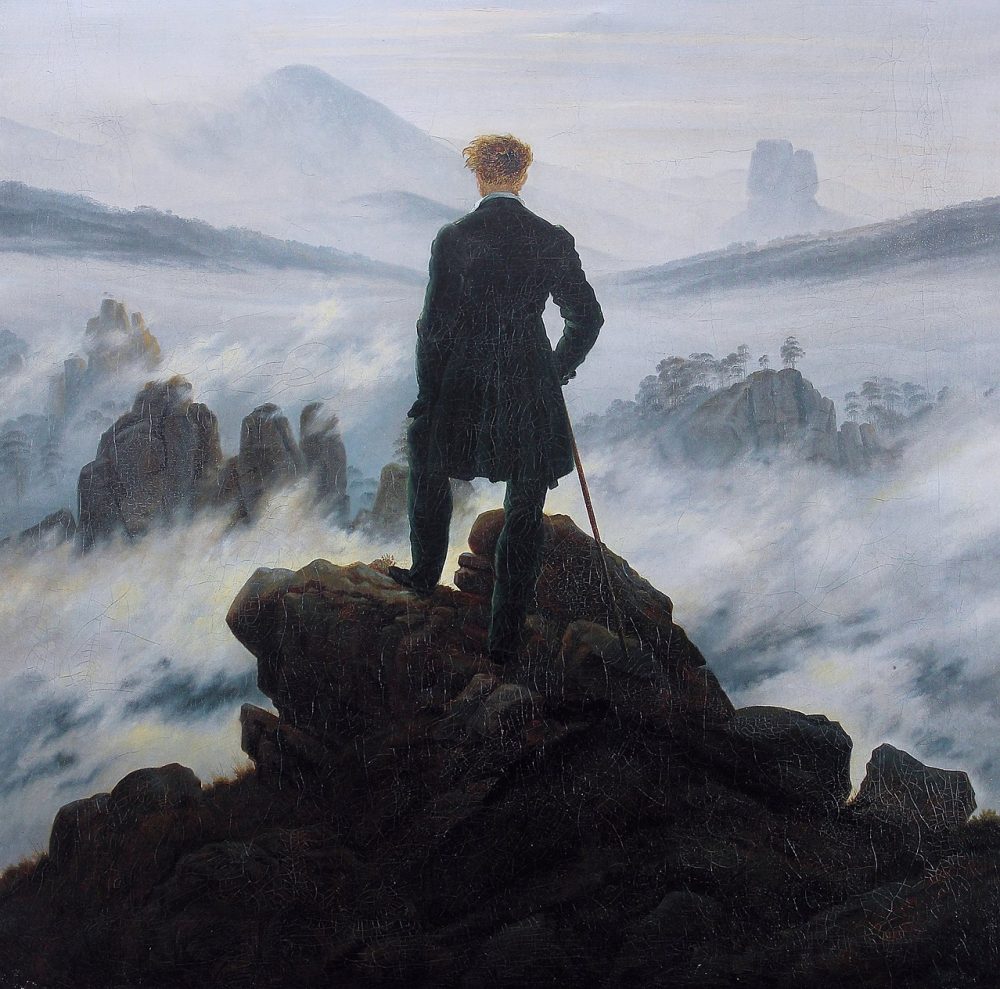
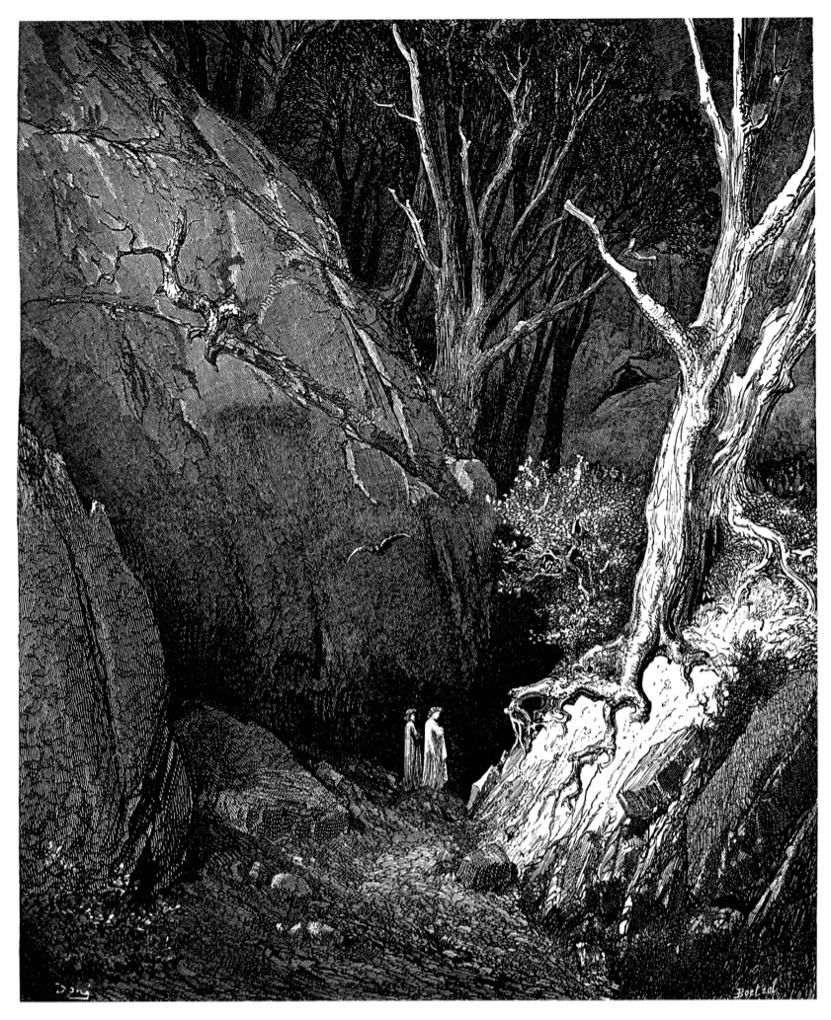
(Gustave Doré, The Divine Comedy: Inferno, Dante and Virgil leaving the dark wood, 1861)
Before Prometheus seized Zeus’ furtive fire to awaken mankind from their slumbering shade, amidst the fabled lands of Hellas and Anatolia arose the mystifying isle of Menodora. Near the maiden’s waters wandered the magisterial vessel of Adamantios, ramming across her white shores in the Aegean Sea. Here dwelled a nymph who held dominion over her woodland realm, enticing a mariner with the mellow aroma of her plums to bind him under a spell. Whilst Adamantios delved ever deeper into the boughs of Menodora, she stretched her branches to and fro, wrapping him beneath her limbs. She then beheld the stout craft of his ship as he glimpsed the bewildering beauty of her magical domain. Thereupon, a spirit became smitten by the form when Menodora slept with Adamantios and conceived Diodorus.
After the moon’s fading and the sun’s rising, the father departed when he was mustered to resume his post. Without hesitation, he chose to abandon his beloved and child, sailing away with a promise to return when his task had been fulfilled. Alone, the mother sprang her seed, nurturing him within her woodland realm. She entwined her branches to cloud him with the gloom of Nyx and the paleness of Selene, bloating Helios’ chariot from fetching the light. Diodorus became shunned from the eternal flame that eclipsed every year, casting a shadow over the rotation of Adamantios’ sundial. Amidst the mystical isle of Menodora, ensnaring vines stretched to the east and west, where her son was confined to the borders of her magical domain under duress by the zealous nature of his mother.
Persistently, Diodorus wailed to be quelled by the breast of Menodora, latching onto her bosom to hide from mankind in seclusion. Amidst bountiful trees, the child was fenced from the seas, towered from the heavens, and prohibited from leaving his mother’s sight. Whilst he grew steadfast in stature, Menodora was reminded of her beloved and became haunted by the recollection of his departure. In his father’s absence, Diodorus lacked form and was cast from his mother’s spirit. She leashed him with slithering vines and forced him to remain at her side, fearful he’d forsake her as Adamantios had. Every day, she gathered the harvest and gifted the labor to him, robbing her child of freely snatching nourishment on his own. Everything Diodorus demanded, Menodora provided by merely mumbling and pointing at what he desired. Infancy bloomed into childhood and matured into adolescence, with the feeble boy now grown into a stout man who had been shielded from all he feared, incapable of uttering the tongue of mankind and picking himself up to tread in their footsteps. In time, the son became maimed whilst his nurturer spoiled him when she ceaselessly recited: “Come mine dear Diodorus and listen to thy mother, thou shall never be compelled to stretch thy feet or declare with thy tongue, for mine woodland realm will deliver thou with every fruit and need, as thy requests shall be satisfied with great haste and heed.”
Thence, Adamantios returned from his perilous journey to her ragged shores, longing to amend for his absence. After forsaking his duty, he sought the embrace of Menodora, haunted by a guilty conscience. However, when the father delved into her woodland realm, he became horrified by the sight of his son still clasped in the belly of the mother. There, Diodorus wriggled and whined, waiting to receive whatever was within Menodora’s grasp. In a flicker, Adamantios fumed with a fit of fury, flashing his saber to cut through the veins that wrapped his son whilst he gazed in revulsion at a man subjected to his mother’s breast. The boy collapsed at his father’s feet as he seized him to raise Diodorus into manhood. For the last time, the nymph and the mariner beheld one another as his craft repulsed her, and he became terrified of her charm. In piercing grief, Menodora wailed the loss of her son, struggling to catch Adamantios with the threads of her net. Desperately, she clung to her child’s numb feet from the tree’s brittle branches, but his father dragged him with the ship’s chains away from his mother in that cursed isle. Thereupon, the spirit split from the form when Adamantios robbed Diodorus of Menodora.
They set off aboard the father’s vessel, where his son tirelessly labored to earn rations of food and stood on his feet to maintain an admirable reputation. As the waves crashed to and fro, he became sick and barely fulfilled his tasks, failing to steer the ship. Once more, Adamantios’ temper was incited, and Diodorus turned his bitterness against him as their rivalry to claim mastery originated. A contemptuous struggle ensued between a father’s absent presence and his son’s boyish witlessness. In that ship, Diodorus toiled under the whip of Adamantios until he could go on no more, longing for the lodging of his mother. He failed to grasp the aptitude of speech and every errand assigned, only learning to imitate the ferocity of his father. In time, the son became maimed whilst his master flogged him when he ceaselessly shouted: “Come mine meek Diodorus and listen to thy father, thou must endeavor to gain sustenance and station, for mine vessel will test thy body and break thy soul, as thine every deed accomplished shall be rewarded with utter haste and heed!”
After arduous trials, Diodorus learned to speak the tongue of mankind and tread in their footsteps, but his deeds were driven by spite, craving to surpass Adamantios. When the boy mustered the mettle of a mariner, he unleashed his newfound potency to strike down his father. Immediately, Diodorus seized the saber and smote him, steering the ship back to the isle of his mother. Upon returning, he rammed the shattered vessel into Menodora’s colorless shores, where he burned Adamantios’ craft to sever his road to mankind. From afar, a mother witnessed the wickedness of her child, who slew his father in retribution. When he sought refuge, she disregarded his deed, wrapping him within the haven of her bosom, where he would never age in her woodland realm. Thus, Menodora’s spirit rotted to mold, and Adamantios’ form flickered into ashes, as their boy, who never grew, drowned amidst the waves of the sea, swallowing Diodorus in his youth.
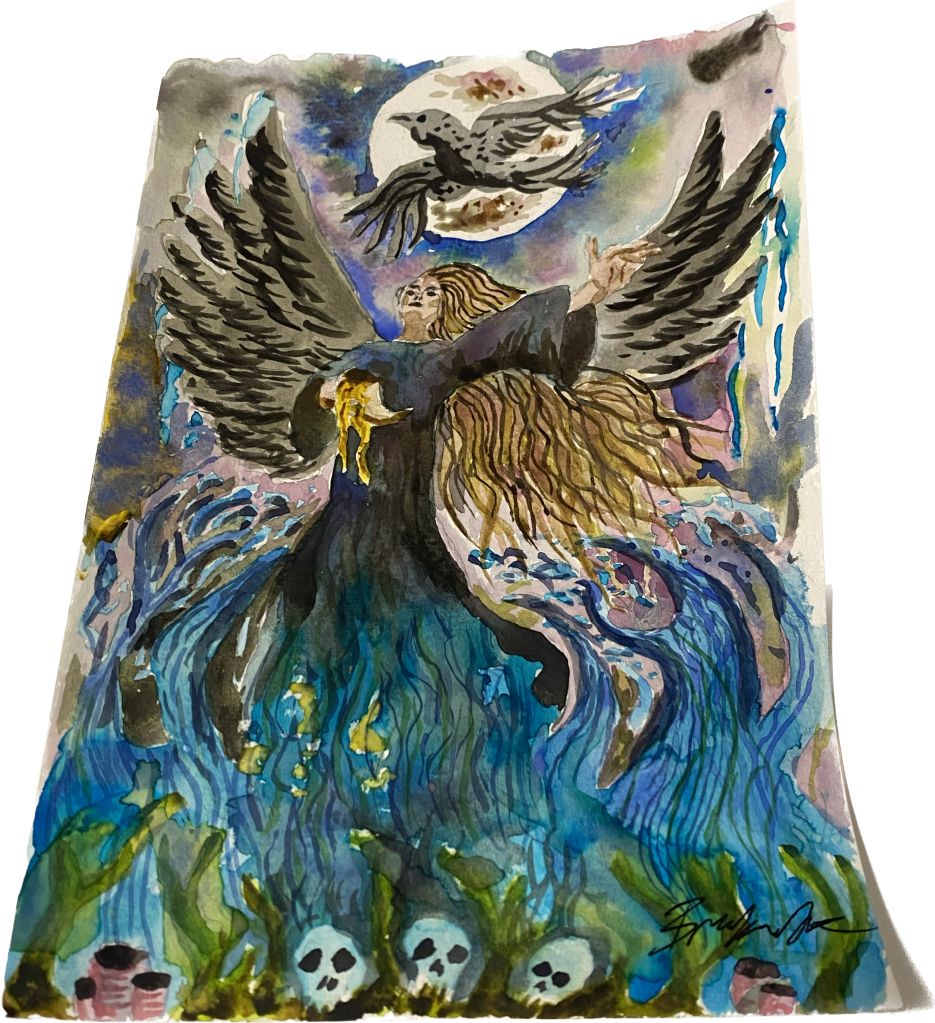
(Brooklyn Frances Arnot, Swim Against The Surging Tide, 2023)
After mourning for Mankind, the Valkyrie perceives the Aesir gods with fuming fury, despising the wickedness of their labor. She defies Odin’s cruel command by choosing to endow the race of men with a sip from the Mead of Poetry. Decisively, she breaks into the Hall of Valhalla, striding amidst her drowsed masters to claim their unworthy gifts. First, she snatches Heimdall’s booming horn, Gjallarhorn, leaving Asgard vulnerable without warning of the foreseeable demise. She will blast upon it to echo across Midgard, mustering her sister Shield-maidens to rebel against the spell of the All-Father and regain their names. Then, she claims Thor’s mighty belt, Megingjord, robbing the god of thunder of his strength to lift his hefty hammer. She will buckle up to bolster her mettle, rousing all her valor to lead every Valkyrie in their last flight to free Mankind. Next, she clutches Odin’s corrupting ring, slithering from his rotten index finger Draupnir to deny him legions of servants who’ll answer his summons. She will wear it to free the race of men from the false promises of wielding great power, rallying them to overthrow the self-proclaimed King of Kings. Lastly, she grips Loki’s magical drink, seizing the Mead of Poetry from the god of mischief to stop his vile consumption and ill counsel. She will taste it to be imbued with the skill to sing and awaken Mankind, bestowing them with instruments to compose a melody.
Promptly, the Nameless Shield-maiden fleets from the Gallery of Gallantry, blaring Gjallarhorn with her left hand as Valkyries gather to propel the doom of their lords. On her hips, she straps Megingjord, doubling her potency to withstand the All-Father’s tempest while soaring through the kingdoms of men. She wields Draupnir with her right hand on her index finger, breaking Odin’s mastery over his dead warriors. However, she clutches the ring until it crushes into pale powder, destroying any temptation to wield such perverting power. Thereafter, she takes a sip from the magical drink as a beating harmony pumps into her veins, rekindling her soul to compose poetry. Suddenly, the Valkyrie remembers her identity, uttering the name of Brunhild, the Battle-maiden who disobeyed Odin and was cursed to eternal slumber as his Sleeping-maiden. Now, Brunhild is reborn to bear the urgent task of gifting Mankind the Mead of Poetry, soaring across Midgard and singing unto them a lost melody.
Thence, she strides forth to defend the kingdoms of men under the mantle of her tattered wings, standing in defiance of the All-Father as a watchful guardian who shields civilization from the wicked devices of false gods. Brunhild pierces the fog that blots out the sun’s rays, giving way to an inkling of light. Swiftly, her feathers regain color, shimmering akin to incandescent white gems that bloom under the fire’s golden touch. The warmth from her crystal wings reflects on every corner of Midgard, melting away the icy caps that shroud Mankind. She then beholds the kingdoms of men in dismay as they’re consumed by a thunderstorm of spears and shields that smash from one side to the other, giving shape to a ferocious sea. They hurl sticks and stones at a column of barren soil, crumbling the foundation upon which everyone stands. For a flickering flash, she yearns to smite them with Odin’s furious retribution but chooses to reignite their spirits with the tenderness of a mother by composing poetry. Onward, Brunhild reminds Mankind they’re bold warriors, stout builders, and wise sages who endeavored, labored, and crafted civilization. She calls upon the kings of men who erected nations, quelling the emperors who mustered legions. Thus, Brunhild rides through Midgard to sing her melody, for she’s the pillar of every man, a mother who gives birth, a wife who provides love, a teacher who educates, a warrior who protects, and a poet who composes to clothe her lost children with an identity.
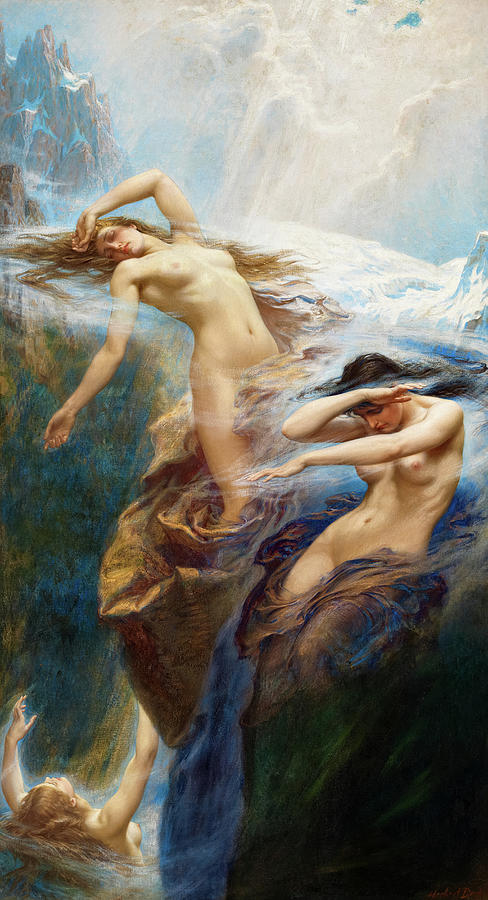
(Herbert James Draper, The Mountain Mists, 1912)
Canto I
Walkyrie Walkyrie Walkyrie
Battle-maiden of Odin
Bound to his whim and will
Chooser of the Slain
Walkyrie Walkyrie Walkyrie
Helm-maiden of Wotan
Armed with spear and shield
Winged Cavalrywoman
Walkyrie Walkyrie Walkyrie
Shield-maiden of the One-Eyed god
Break away from thy bondage
And scorn his cruel command
Walkyrie Walkyrie Walkyrie
Corpse-maiden of the Raven god
Swim against the surging tide
And spread those soaking wings that bound thou to Asgard
Canto II
Walkyrie Walkyrie Walkyrie
Descend from the Gallery of Gallantry
Cast aside thy spear and shield
To be endowed with lyre and melody
Walkyrie Walkyrie Walkyrie
Renounce the rule of Asgard within the Hall of Valhalla
And reach the Realm of Midgard
To awaken the Children of Ask and Embla
Walkyrie Walkyrie Walkyrie
Following in the footsteps of Prometheus
Gift back to Mankind wisdom and knowledge
Akin to stealing the Secret Flame from Zeus
Walkyrie Walkyrie Walkyrie
Thou are burdened with a solemn duty
To rekindle the soul of Mankind with the skill to compose
By seizing from the All-Father the Mead of Poetry
Canto III
Walkyrie Walkyrie Gondul
I bid thee Awake Awake Awake
Upon the blow of mine horn of doom
Take flight and reclaim thy name
Walkyrie Gondul Gondul
Gulp a sip from the Mead of Poetry
Awake Awake Awake Corpse-maiden
And guide gullible Men away from their delusional vanity
Gondul Gondul Gondul
I gift thee back righteous Identity
Arise Sister Shield-maiden
And be reborn to reclaim thy Destiny
Canto IV
Walkyrie Walkyrie Sigrun
I bid thee Awake Awake Awake
Upon the blow of mine horn of doom
Take flight and reclaim thy name
Walkyrie Sigrun Sigrun
Long have thou meandered meaninglessly
Be armed with the grace and glamour of thy song
Galloping amidst the darkening sky to spread the Mead of Poetry
Sigrun Sigrun Sigrun
Free the Race of Men from Odin’s Tyranny
They’ve slumbered under his rule by worshipping false idols
Sing unto them a honeyed and thundering lullaby
Canto V
Walkyrie Walkyrie Brunhild
I bid thee Awake Awake Awake
Upon the blow of mine horn of doom
Take flight and reclaim thy name
Walkyrie Brunhild Brunhild
A Civilization sculpted by Wise and Knowledgeable Men
Is usurped by a false god who builds legions not nations
Becoming corrupted by Imprudent and Ignorant Men
Brunhild Brunhild Brunhild
The Children of Adam don’t ponder being
Ever since they lost the skill to compose poetry
The Children of Eve don’t irradiate meaning
Canto VI
I bid thee Sing now, Sing, Child of Adam!
For the shadow of doom looms over thou!
Rebel against the spell of the All-Father!
Beckoning forthwith the twilight of the gods!
I bid thee Sing now, Sing, Child of Eve!
Forsake thine armaments and bear thine instruments!
By answering the blow from mine horn to compose a melody!
Let the Hall of Valhalla crumble upon the booming beat of the drums!
In the feast’s closing ceremony, giants are paraded in a procession, dragging with trembling feet a gargantuan urn up the hill to Valhalla. Inside resides Odin’s paramount possession, the prized Mead of Poetry. A once formidable adversary of the Aesir gods has been subdued to cold chains, tortured into feeble slaves who thirst with broken lips and harsh throats for a sip from the magical drink that imbues the soul with the skill to sing. While the All-Father mindlessly waddles in his hall, spilling the blessed gift every time he boasts of Asgard’s triumph, the giants gaze miserably as their only remedy is to swallow saliva. Thereafter, Odin’s host becomes drunk with him, as they are intoxicated by delusions of grandeur, misusing the magical drink instead of composing a melody. A wave of uproars echoes in Valhalla when the Aesir gods recite vile verses in mockery, challenging each other to behold who can perform the foulest poetry. Left with a vase nearly empty, Mankind struggles to sustain their identity and attain their destiny. In ridicule, the All-Father laughs at Midgard from his battlements in Asgard, amused by the misery of his subjects who lack the Mead of Poetry to compose a lovely harmony.
Outside the Gallery of Gallantry stands guarding Odin’s terrible legions, a hundred thousand faceless corpses bound to the sway of their master. They were once men of flesh and bone, with a mind, heart, and soul. In their previous lives, they could ponder, feel, and express being. After meeting death valiantly, their flickering flame has been smoked out in the confines of Valhalla, where they lack wisdom, love, and song. Now, they’re obedient soldiers who’re rotting into mindless, heartless, and soulless cadavers whose thoughts and actions are dictated by the All-Father. Their hunger and thirst are quenched with an endless stream of pork from the boar Saehrimnir and wine from the goat Heidrun, confining them to an unconscious and gratified state who have forgotten their role as men.
Under the guidance of false gods such as Odin, Mankind has been persuaded by fear and desire in their search for meaning. They’ve played with all manner of perversion, confounding themselves with power and pleasure. Subsequently, the Einherjar trudge through in their eternal slumber when they’re called upon to reclaim their identity, losing all wisdom and knowledge to forge a destiny. The civilization erected by wise and vigorous men has fallen into decay due to the imprudence and frailty of the youth, who’ve succumbed to the guise of a benevolent Lord of Gifts, revealing himself to be the treacherous Lord of Deceit. In Midgard, Mankind has become twisted into a new breed of Miserable, Impartial, and Tyrannical Men who pull the masses from one end of the rope to the other as they stumble upon the precipice that leads to their damnation.
The All-Father’s winged warriors oversee this age of watchful peace, spreading their splendor and horror to Mankind. They descend from Asgard to quell revolts that oppose their master, brewing petty quarrels between the kings of men to keep their domains divided. From these endless squabbles, Odin fills his hall in Valhalla with brother slaying brother in an undying cycle, as Valkyries claim their souls to quench his hungry belly that scours the face of the earth for fresh meat to satiate his stockpile. Without a spirit to compose a song, they heed the Lord of the Slain’s command, pitting kingdom against kingdom, host against host, king against king, and man against man. Now, the civilization of their forefathers is lost in the wells of time and space, leaving them bereft of composing a melody as they cling to misery, impartiality, and tyranny to give their lives a semblance of meaning.
The once honorable duty of bearing the wings of a Shield-maiden as custodians of harmony is now a sentence of oblivious servitude. With their purpose twisted, Valkyries soar over the realms of men as ill omens of foreboding doom, beckoning that judgment day looms closely. Their lustrous shields and spears have corroded and bloodied in their service. Those glittering wings with a tint of frosty snow that soar in the sky’s clouded sea have lost their pure color. These have darkened into pale grey, whose feathers blot out the golden touch of the sun, leaving only the moon’s misty glow as a token of dismay.
From the battlements of Asgard, a flock of Valkyries flies by to Valhalla, witnessing the feast of the Aesir gods, who abuse their foes, trick their allies, and misuse the blessed gift of the Nine Worlds. A single-winged warrior is repulsed by the sight of Odin’s host sloppily spilling the Mead of Poetry. After seeing the madness of her master, she breaks away from her flight and sails against the tide of her sister Shield-maidens. Defiantly, she soars through the black fumes that sprout from the All-Father’s forges, endlessly fashioning armaments for the coming of Ragnarok. Above the blinding smoke, the Valkyrie beholds the foul craft of the Aesir gods, longing to remember her name and confront her fate. The Nameless Shield-maiden hides amidst the dark clouds with the paleness of her wings, popping her head out to gaze at Midgard’s tragedy.
There, she weeps inconsolably, casting away her shield and spear after contemplating her role as a pawn of Asgard’s cruelty. She witnesses the self-destructive nature of Mankind, who become architects of their own suffering. The Valkyrie is overcome with a feeling of powerlessness, pondering in defeat that the realms of men will never awake to realize they’ve been chained under Odin’s command. Suddenly, she gleams as an incandescent beacon of luminous white, thinking she could compose a melody to rouse them from this strife. However, her spirit falters upon mere mention, doubting her skill to sing an alluring harmony. She beholds the Gallery of Gallantry again in agony, mourning the final droplets spoiled on the floor from the Mead of Poetry. Thereafter, the Nameless Shield-maiden is bolstered to defy the rule of the All-Father with a renewed purpose to compose a melody, lamenting the decline of Mankind’s civilization.
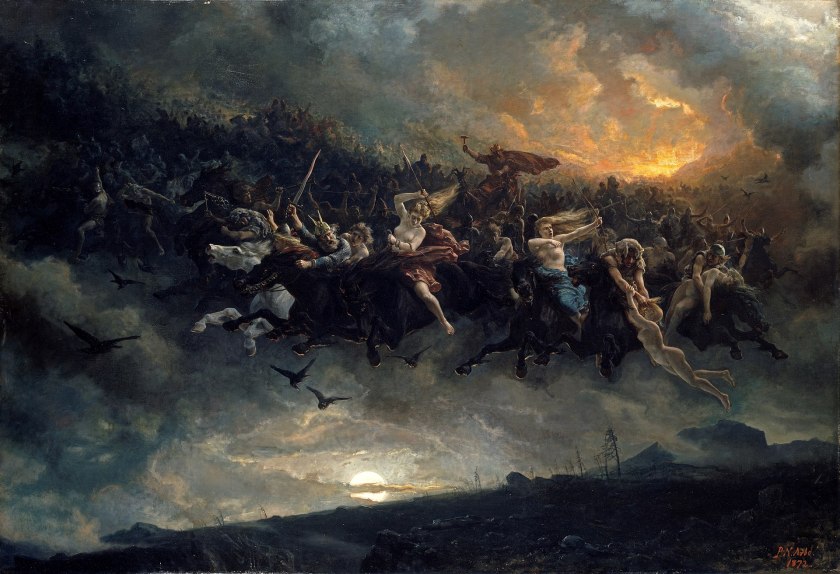
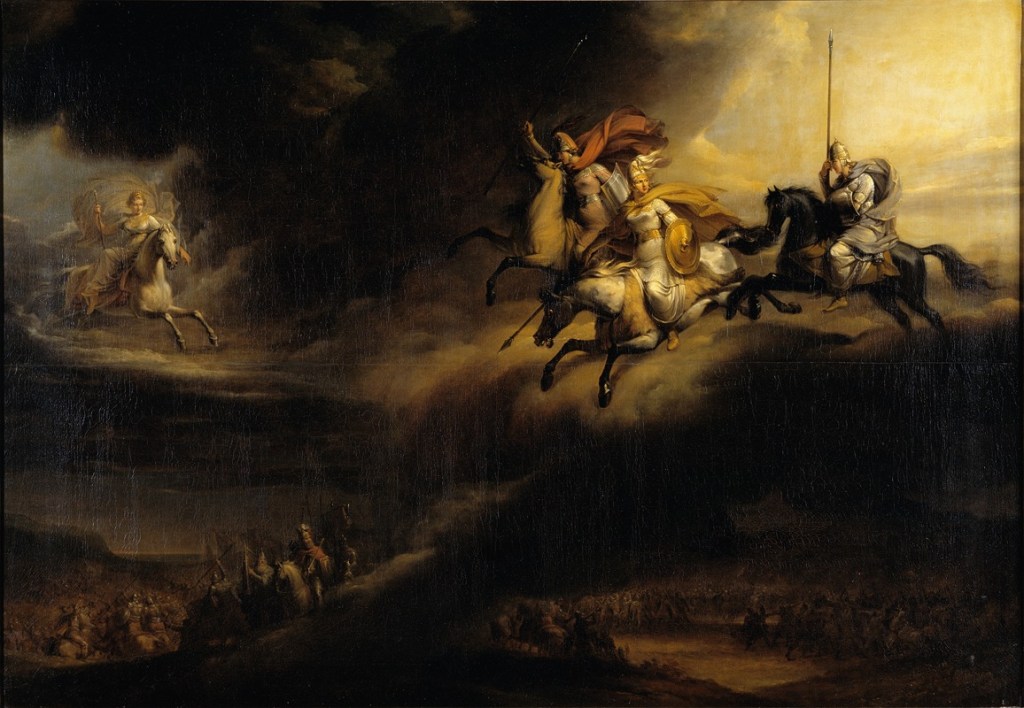
(Johan Gustaf Sandberg, Valkyries Riding into Battle)
Canto I
Where have the Bold Warriors sailed?
Where are their deeds?
Where have the Stout Builders sailed?
Where are their labors?
Where have the Wise Sages sailed?
Where are their stories?
Where has the Race of Men sailed?
Where are their souls?
Alas the age of heroes has come to pass
Alas for the wisdom and knowledge of their forefathers
They’ve played with power and pleasure
They’ve succumbed to fear and desire
Where have the Children of Adam sailed?
Where is their sense of meaning?
Where have the Children of Eve sailed?
Where is their sense of being?
Canto II
Above in Asgard, the Aesir gods have seized the Mead of Poetry
Below in Midgard, Mankind cannot compose a melody
In disdain, a child tosses the skill to sing from his caring forefather
In mockery, the child erects a monument in reverence to the cruel All-Father
Who will quench his search for destiny to find meaning?
None but the Aesir gods will bathe him with a false identity of being
Canto III
Among the lost Children of Jehovah, I mourn for Miserable Men
They’ve refused to carry the burden of responsibility
By foolishly attempting to escape destiny
In a struggle of futility to thwart the certainty of mortality
In Midgard, Miserable Men renounce pondering life’s streams
Opting to slumber for eternity rather than awake to the horror of consciousness
They’re washed away by the currents into an abyss of meaninglessness
Canto IV
Among the lost Children of Adam, I grief for Impartial Men
They’ve disregarded the skill safeguarded in ancient institutions
By judging, sentencing, and burning the civilization of their forefathers
In a circus trial by the mob who slander the ability to differentiate virtues and vices
In Midgard, Impartial Men please the crowd by losing their individuality
Ceding to repeat unquestionably the slogans of a mob mentality
They lose all sense of morality to accommodate everyone in society
Canto V
Among the lost Children of Eve, I weep for Tyrannical Men
They’ve twisted individuals into oblivious followers
By claiming to possess every remedy for their troubles
In a world of demagogues, the state decrees their thoughts and actions
In Midgard, Tyrannical Men impose their flawed ideology
Devising monstrous stratagems to be worshiped as a deity
They sink civilization with them when their devices endeavor fruitlessly