Posted in Library of Alexandria, Marcus Aurelius' Meditations

Marcus Aurelius’ Meditations III

By: Bryan Ricardo Marini Quintana
Moreover, Meditations harkens back to the philosophy of the Socratics with Epictetus’ teachings on the principles of moral virtue. Here, the Emperor contemplated how to discover his spiritual voice and speak with his “dæmon” to live in agreement with the universal nature. This brought Marcus Aurelius in contact with divine counsel, as the “logos” advised him to pursue what was meaningful and avoid distractions. Among these troubles, he warned himself against chasing after worldly desires and bursting out in fits of anger. Marcus Aurelius voiced this struggle to care for one’s soul by controlling his impulses when he conveyed: “Repentance is a kind of self-reproof for having neglected something useful; but that which is good must be something useful, and the perfect good man should look after it. But no such man would ever repent of having refused any sensual pleasure. Pleasure then is neither good nor useful.” (Meditations 75)

Then, the Emperor reasoned that he must balance his spirit and the universal law governing outer events, including the unpredictable nature of confronting pain. Since he had no influence over his surroundings, Marcus Aurelius pondered how he could endure an unfavorable outcome and accept the experience with a calm posture. To resolve this dilemma, he argued that the harmful deeds of others didn’t impact his nature; instead, the Emperor’s response to this injury defined his character. Marcus Aurelius displayed his resolve to stomach hardship when he articulated: “For he who yields to pain and he who yields to anger, both are wounded and both submit.” (Meditations 118) Often, the Emperor grasped that his mind’s outlook on a problem was potent enough to alleviate or increase his wound’s anguish. Only by learning to control how he perceived a harmful occurrence could he gain inner peace with his “dæmon” and “logos” instead of falling into distress. Accordingly, Marcus Aurelius sought a balance with the universal nature, understanding he held no power over his environment but only how he responded by reflecting: “Wipe out thy imagination by often saying to thyself: now it is in my power to let no badness be in this soul, nor desire, nor any perturbation at all; but looking at all things I see what is their nature, and I use each according to its value. Remember this power which thou hast from nature.” (Meditations 79)

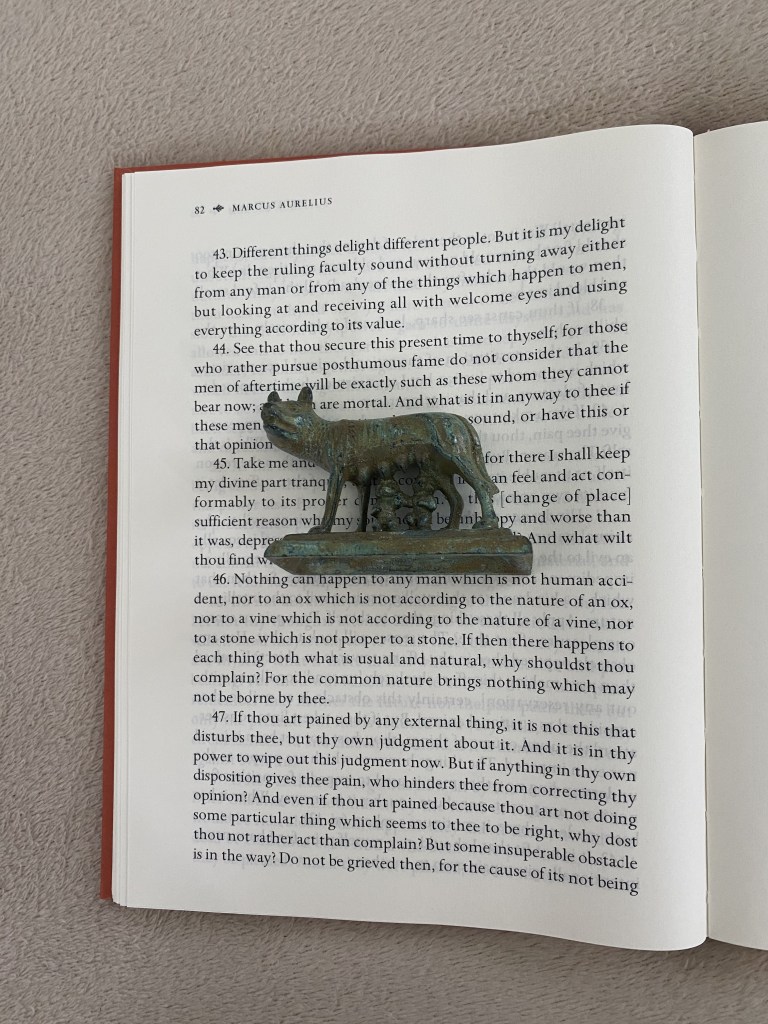
Afterward, the Emperor discussed that a pivotal lesson of Stoicism is that happiness becomes the responsibility of every individual, with the quality of his thoughts shaping a man’s attitude. Consequently, his surroundings can deal a good or bad hand regardless of one’s character. However, Marcus Aurelius didn’t hold himself answerable for the world’s nature but was only accountable for his reaction when facing tragedy by contemplating: “If thou art pained by any external thing, it is not this that disturbs thee, but thy own judgment about it. And it is in thy power to wipe out this judgment now.” (Meditations 82) Therefore, the Emperor understood that he could revoke the notion of whatever disturbed his harmony, exercising power over his mind’s opinion about that which troubled him. 

Overall, Meditations records Marcus Aurelius’ personal reflections on how to lead a virtuous life in accordance with the teachings of Stoic Philosophy. Throughout his reign, he relished a life of luxuries fit for a Roman Emperor. He was free to abuse his authority with prideful ambitions that would’ve seen him indulge in every vice, from fleeting pleasure to spewing anger. Nevertheless, he chose to rule Rome’s powerful economic and military force under the beliefs of Stoicism. In his daily life, Marcus Aurelius practiced humility, patience, and gratitude when addressing the challenging predicaments of upholding his character or the numerous crises faced by the Roman Empire. Above all, the Emperor consulted his “dæmon” or “logos” for spiritual guidance and divine wisdom to contemplate the principles of universal change while leading a life of moral virtue. Hence, Meditations serves as the archetypal work of Stoic Philosophy that preserves Marcus Aurelius’ implicit teachings on how to practice wisdom, justice, fortitude, and moderation to master the self, as the Roman Emperor’s pursuit to live righteously in accordance with nature while building a relationship with his innermost soul immortalized him for generations of readers as the Philosopher-King from the Greco-Roman World.

Posted in Library of Alexandria, Marcus Aurelius' Meditations

Marcus Aurelius’ Meditations II

By: Bryan Ricardo Marini Quintana

In Meditations, the Emperor reflected on how to lead a virtuous life in accordance with four chief virtues that allow a man to live in harmony with nature. These are categorized into wisdom, justice, fortitude, and moderation. Throughout the text, Marcus Aurelius explored how to deduce a man’s character based on his moral or immoral behavior by declaring: “If it is not right, do not do it: if it is not true, do not say it.” (Meditations 126) Alongside, he pondered how everyone is destined to receive his rightful due and should be prepared to face the consequences of his actions. Next, the Emperor contemplated the importance of persevering amidst the constant toiling and suffering that must be tolerated in life. Finally, Marcus Aurelius remarked on how to live in utter simplicity by employing self-discipline toward the proclivity for earthly desires. 

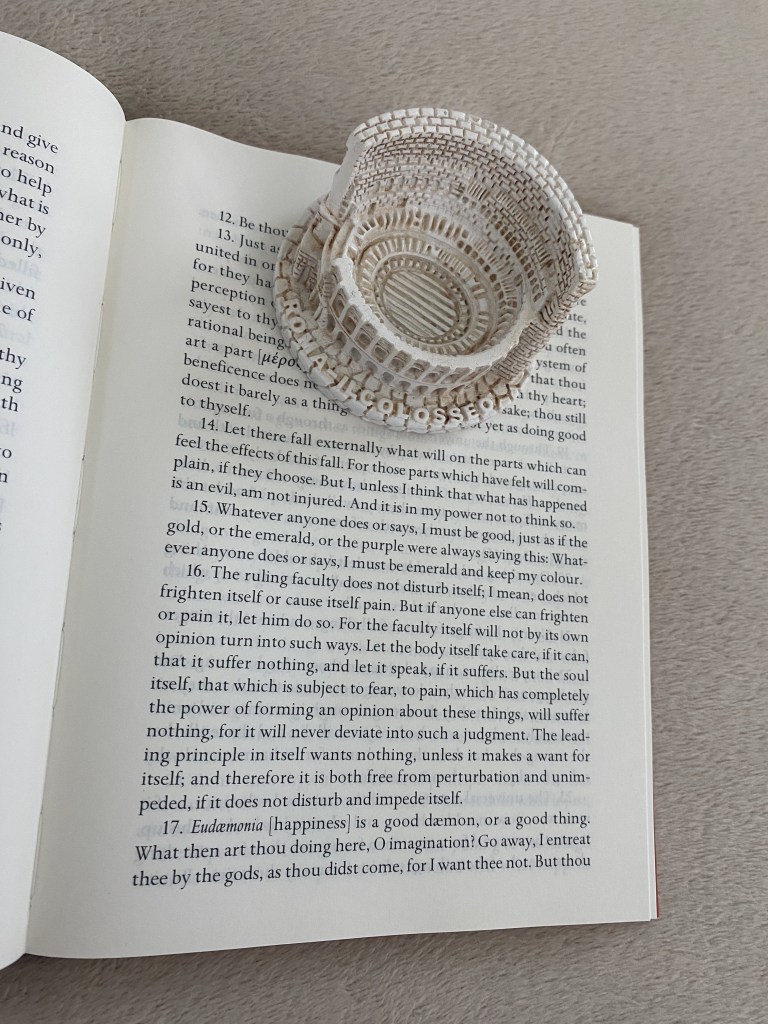
A critical teaching reverberating in Meditations is the mastery of the self, with the Emperor expressing a need to conquer his emotions. Here, he observed that one must learn to overcome his fits of passion or risk falling into an adrenaline rush of poor decision-making. From this philosophical thought, Marcus Aurelius affirmed: “Be thou erect, or be made erect.” (Meditations 63) Only by gaining control over his impulses, could he learn to live judiciously and purposely. Although Marcus Aurelius would experience pleasure, anger, grief, despair, temptation, and pain, these would not influence his reaction to outer events. By subduing his emotions, the Emperor maintained the ruling faculties that defined his character, leading to a more fulfilling human experience by finding happiness through a stable life of inner peace. Another personal reflection of Marcus Aurelius clarified this when he said: “Whatever anyone does or says, I must be good, just as if the gold, or the emerald, or the purple were saying this: Whatever anyone does or says, I must be emerald and keep my colour.” (Meditations 63)

Furthermore, the Emperor echoed the philosophy of the Pre-Socratics with Heraclitus’ teachings on the world’s nature and the principle of universal change. Firstly, he wondered why men should fear transformation when this is a natural stage of maturity between an individual and his environment. Both require alteration to uncover their true visage, meaning that for a garden to bloom in the spring, one must risk its withering in the fall. When speaking of change, Marcus Aurelius ruminated: “Is any man afraid of change? Why, what can take place without change? What then is more pleasing and more suitable to the universal nature?” (Meditations 64)

Alongside, the Emperor deduced the finite scope of human life and how insignificant it is to desire marble monuments in one’s name when none will be there to remember. He reasoned that everyone is destined to perish due to the nature of men, governed by the universal law of transformation. However, some seek to be immortalized with a vainglorious recollection of themselves, appealing to the adoring masses for their deeds to live on through them. Nevertheless, he concluded that this proud act to achieve immortality beyond death is not worth pursuing due to the far-reaching and ever-stretching sands of time that sooner or later wipe out the prideful from all memory. When examining the fate of mortals and their eventual fading from history, Marcus Aurelius expressed: “For all things soon pass away and become a mere tale, and complete oblivion soon buries them. And I say this for those who have shone in a wondrous way. For the rest, as soon as they have breathed out their breath, they are gone, and no man speaks of them. And to conclude the matter, what is even an eternal remembrance? A mere nothing.” (Meditations 31)

Posted in Library of Alexandria, Marcus Aurelius' Meditations

Marcus Aurelius’ Meditations I

By: Bryan Ricardo Marini Quintana

Meditations is a compendium of Marcus Aurelius’ (121-180 AD) personal reflections, which the Roman Emperor originally wrote to consult and exercise the old wisdom of the Stoics. A Hellenistic philosopher named Zeno (335-256 BC) founded the School of Stoicism, observing that a universal reason governs life, and everyone should strive to live righteously in agreement with it. These Stoics originated in the Greco-Roman World, whose ancient culture instructed individuals to pursue a virtuous life by mastering the self. When facing adversity or despair, Stoicism advised the practice of humility, patience, and gratitude to combat impulsive passions that drive prideful men to lust or wrath. Instead, Stoics counseled communion with the “dæmon” or “logos” within every man’s innermost soul, learning how to discover spiritual guidance and reflect on divine wisdom in accordance with nature. Although Marcus Aurelius recorded his philosophical thoughts to contemplate the principles of Stoicism in private, he never intended to publish his text for public consumption. Therefore, Meditations cannot be approached as an autobiographical work with detailed accounts of his life; rather, it’s a handbook that helped him bond with his “dæmon” or “logos” while training in personal reflections on how to lead a life of virtue.

From an early age, the Emperor relished a life of commodities by benefiting from relatives who held positions of high esteem among the powerful families that influenced the socio-political structure of Rome. Later on, Marcus Aurelius would come into the line of succession when Emperor Hadrian (76-138 AD) named his uncle, Antoninus Pius (86-161 AD), his sole heir. In turn, he adopted Marcus Aurelius and his brother Lucius Verus (130-169 AD) to become joint Emperors upon his passing. From Augustus’ rise to power as the first Caesar (63 BC-14 AD) until Marcus Aurelius’ reign as a successor of the Nerva-Antonine Dynasty, the Roman Empire experienced 200 years of Roman Peace known as the “Pax-Romana” (27 BC-180 AD). During these two centuries, Rome flourished economically and culturally, with massive funds for public works that displayed the splendor of these Emperors with the building of roads, arches, walls, temples, palaces, theaters, and cities. Upon assuming the throne, Marcus Aurelius inherited a prosperous Roman Empire ruled in succession by Nerva (20-98 AD), Trajan (53-117 AD), Hadrian, and Pius, who became venerated as The Five Good Emperors.

During his rule, Marcus Aurelius faced various crises that tested his capabilities to administrate the Roman Empire. Among these was the rapid conversion of Christians across the eastern provinces, whose persecution continued from his predecessors under his rule. Furthermore, the Emperor came into conflict with the Parthian Empire in the Roman-Parthian War (161-166 AD), which brought military victory but at the cost of spreading back home the Antonine Plague (165-190 AD). Moreover, a series of clashes ensued with the Germanic Tribes across the Danube River in the Marcomannic Wars (166-180 AD). During his campaigns in the Roman Frontier, Marcus Aurelius began writing Meditations amidst a violent struggle that consumed much of his life, with the triumphant aftermath exposing vital weaknesses in Rome’s northern border. 

In his education, the Emperor studied the ideas of Socrates (470-399 BC), Plato (428/427-348/347 BC), and Aristotle (384-322 BC). The Fathers of Philosophy introduced him to the concepts of caring for one’s soul, the link between a physical and celestial realm, and how to lead a life of moral virtue. However, the most influential teachings came from Pre-Socratic philosopher Heraclitus (540-480 BC) and Socratic philosopher Epictetus (55-135 AD). On one side, the Pre-Socratics, preceding Socrates, were concerned with how the world’s nature becomes entwined with man. This is illustrated by Heraclitus, who believed that the principle of the universe is a constant state of change, where life is an ever-flowing stream. Subsequently, transformation isn’t only a necessity for men and their surroundings, but it’s also a natural alteration. The philosopher understood this as a universal law of birth, growth, climax, decay, and death. Among the philosophical thoughts of Heraclitus, the expression that encapsulates his outlook is: “No man ever steps in the same river twice. For it’s not the same river and he’s not the same man.” (The Fragments of Heraclitus) 

Meanwhile, the Socratics, succeeding Socrates, were fixated on the principles of moral virtue by observing how human behavior and notions lead to a noble or depraved life. This is exemplified by Epictetus, who argued that individuals should be held accountable for their conduct, learning to evaluate and regulate themselves. However, the philosopher discussed that, likewise, they cannot dictate the outcome of external circumstances, meaning that these should be embraced with a peaceful attitude to be righteous decision-makers. From Epictetus, a philosophical saying that captures his conviction is: “Circumstances don’t make the man; they merely reveal him to himself.” (The Discourses of Epictetus) Both philosophers, Heraclitus and Epictetus, are mentioned throughout Meditations, with Marcus Aurelius recalling their wisdom when pondering on concepts such as the “dæmon” or “logos” alongside their relation to the universal law and moral virtue. 

Posted in Poems

The Melody of Brunhild

By: Bryan Ricardo Marini Quintana

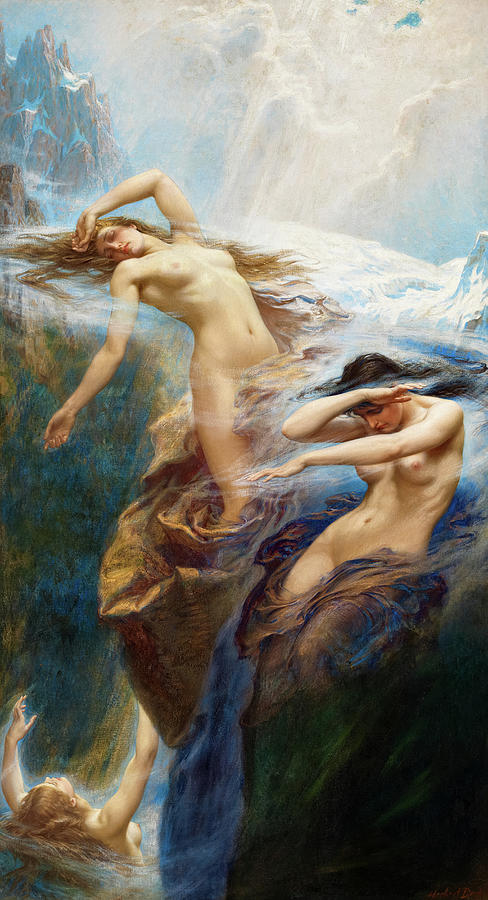
(Herbert James Draper, The Mountain Mists, 1912)

Canto I

Walkyrie Walkyrie Walkyrie

Battle-maiden of Odin

Bound to his whim and will

Chooser of the Slain

Walkyrie Walkyrie Walkyrie

Helm-maiden of Wotan

Armed with spear and shield

Winged Cavalrywoman

Walkyrie Walkyrie Walkyrie

Shield-maiden of the One-Eyed god

Break away from thy bondage

And scorn his cruel command

Walkyrie Walkyrie Walkyrie

Corpse-maiden of the Raven god

Swim against the surging tide

And spread those soaking wings that bound thou to Asgard

Canto II

Walkyrie Walkyrie Walkyrie

Descend from the Gallery of Gallantry

Cast aside thy spear and shield

To be endowed with lyre and melody

Walkyrie Walkyrie Walkyrie

Renounce the rule of Asgard within the Hall of Valhalla

And reach the Realm of Midgard

To awaken the Children of Ask and Embla

Walkyrie Walkyrie Walkyrie

Following in the footsteps of Prometheus

Gift back to Mankind wisdom and knowledge

Akin to stealing the Secret Flame from Zeus

Walkyrie Walkyrie Walkyrie

Thou are burdened with a solemn duty

To rekindle the soul of Mankind with the skill to compose

By seizing from the All-Father the Mead of Poetry

Canto III

Walkyrie Walkyrie Gondul

I bid thee Awake Awake Awake

Upon the blow of mine horn of doom

Take flight and reclaim thy name

Walkyrie Gondul Gondul

Gulp a sip from the Mead of Poetry

Awake Awake Awake Corpse-maiden

 And guide gullible Men away from their delusional vanity

Gondul Gondul Gondul

I gift thee back righteous Identity

Arise Sister Shield-maiden

And be reborn to reclaim thy Destiny

Canto IV

Walkyrie Walkyrie Sigrun

I bid thee Awake Awake Awake

Upon the blow of mine horn of doom

Take flight and reclaim thy name

Walkyrie Sigrun Sigrun

Long have thou meandered meaninglessly

Be armed with the grace and glamour of thy song

Galloping amidst the darkening sky to spread the Mead of Poetry

Sigrun Sigrun Sigrun

Free the Race of Men from Odin’s Tyranny

They’ve slumbered under his rule by worshipping false idols

Sing unto them a honeyed and thundering lullaby

Canto V

Walkyrie Walkyrie Brunhild

I bid thee Awake Awake Awake

Upon the blow of mine horn of doom

Take flight and reclaim thy name

Walkyrie Brunhild Brunhild

A Civilization sculpted by Wise and Knowledgeable Men

Is usurped by a false god who builds legions not nations

Becoming corrupted by Imprudent and Ignorant Men

Brunhild Brunhild Brunhild

The Children of Adam don’t ponder being

Ever since they lost the skill to compose poetry

The Children of Eve don’t irradiate meaning

Canto VI

I bid thee Sing now, Sing, Child of Adam!

For the shadow of doom looms over thou!

Rebel against the spell of the All-Father!

Beckoning forthwith the twilight of the gods!

I bid thee Sing now, Sing, Child of Eve!

Forsake thine armaments and bear thine instruments!

By answering the blow from mine horn to compose a melody!

Let the Hall of Valhalla crumble upon the booming beat of the drums!

Posted in Poems

The Lament of the Valkyrie

By: Bryan Ricardo Marini Quintana

(Johan Gustaf Sandberg, Valkyries Riding into Battle)

Canto I

Where have the Bold Warriors sailed? 

Where are their deeds? 

Where have the Stout Builders sailed? 

Where are their labors?

Where have the Wise Sages sailed?

Where are their stories?

Where has the Race of Men sailed? 

Where are their souls?

Alas the age of heroes has come to pass

Alas for the wisdom and knowledge of their forefathers

They’ve played with power and pleasure

They’ve succumbed to fear and desire

Where have the Children of Adam sailed? 

Where is their sense of meaning? 

Where have the Children of Eve sailed? 

Where is their sense of being? 

Canto II

Above in Asgard, the Aesir gods have seized the Mead of Poetry

Below in Midgard, Mankind cannot compose a melody

In disdain, a child tosses the skill to sing from his caring forefather

In mockery, the child erects a monument in reverence to the cruel All-Father

Who will quench his search for destiny to find meaning?

None but the Aesir gods will bathe him with a false identity of being

Canto III

Among the lost Children of Jehovah, I mourn for Miserable Men 

They’ve refused to carry the burden of responsibility

By foolishly attempting to escape destiny

In a struggle of futility to thwart the certainty of mortality

In Midgard, Miserable Men renounce pondering life’s streams

Opting to slumber for eternity rather than awake to the horror of consciousness

They’re washed away by the currents into an abyss of meaninglessness 

Canto IV

Among the lost Children of Adam, I grief for Impartial Men 

They’ve disregarded the skill safeguarded in ancient institutions

By judging, sentencing, and burning the civilization of their forefathers

In a circus trial by the mob who slander the ability to differentiate

virtues and vices

In Midgard, Impartial Men please the crowd by losing their individuality 

Ceding to repeat unquestionably the slogans of a mob mentality

They lose all sense of morality to accommodate everyone in society 

Canto V

Among the lost Children of Eve, I weep for Tyrannical Men 

They’ve twisted individuals into oblivious followers

By claiming to possess every remedy for their troubles

In a world of demagogues, the state decrees their thoughts and actions 

In Midgard, Tyrannical Men impose their flawed ideology 

Devising monstrous stratagems to be worshiped as a deity

They sink civilization with them when their devices endeavor fruitlessly 

Posted in Poems

The Discord of the All-Father

By: Bryan Ricardo Marini Quintana

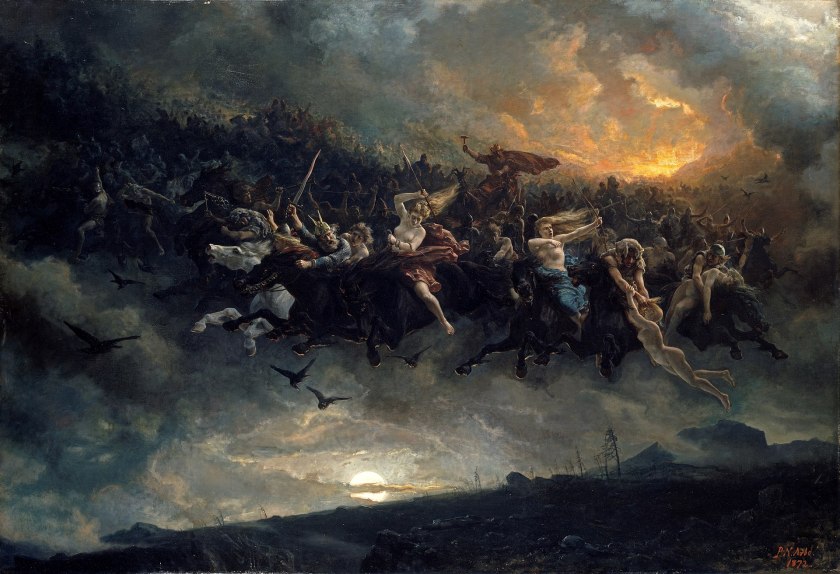
(Peter Nicolai Arbo, The Wild Hunt of Odin, 1872)

Canto I

One eye in sacrifice for the wisdom of foresight from the Norns

This is the price the Aesir god will pay

One eye in exchange for the skill of magic from the Runes

This is the price the Aesir god will pay

Nine days the One-Eyed god hanged

To acquire knowledge of the Realms

Nine nights the One-Eyed god dangled

To acquire knowledge of the Cosmos

Scouring relentlessly to know the fate of every object that could challenge him

Searching ceaselessly to know the doom of every insect that could oppose him

Canto II

Two items the dwarves crafted for him

A Ring called Draupnir

To bend the minds of Men to his whim

Two items the dwarves fashioned for him

A Spear named Gugnir

To succumb the spirits of Men to his will

For his son, Thor, they gifted him the Hammer Mjolnir 

Fighting off the Frost Giants from Jotunheim

For his guardian, Heimdall, they gifted him the Horn Gjallarhorn

Warning of the Fire Giants from Muspelheim

Canto III

In perpetuity, every ninth night, eight rings drip from Draupnir

Bestowing the Race of Men with glimmering golden crowns

To corrupt their souls with delusions of grandeur

Within the Gallery of Gallantry, where the Lord of the Slain resides

Until the doom of the gods,

The Discord of the All-Father disturbed

By twisting Just Kings into Cruel Emperors

Until the twilight of the gods,

The Melody of the Valkyries will be quelled

Within the Hall of Valhalla, where the All-Father resides