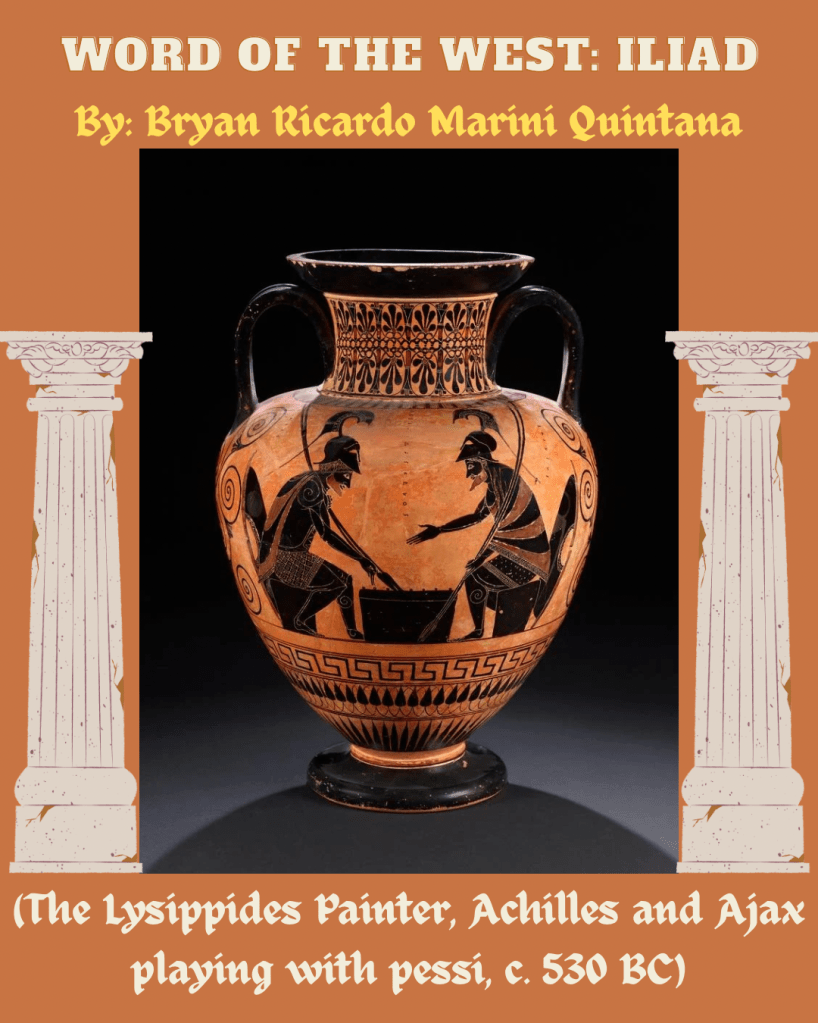
By: Bryan Ricardo Marini Quintana

Part I: The Death of Homeric Heroism
Tell me, oh muse, of a complicated man… or was he of many ways, twists, and turns? If you’ve been to the cinema lately, Christopher Nolan’s The Odyssey (2026) is all the talk. Throughout the film, Odysseus is portrayed as a difficult and distressed man who is not only burdened by Troy’s Ghost, but also by his desire to be reunited with his wife and son in Ithaca. This most recent adaptation has left audiences wondering which translation he consulted to bring Homer’s Epic Poem to the big screen. Furthermore, it’s relevant to ask whether Nolan’s The Odyssey has faithfully ‘adapted’ (translated) the eponymous hero as a cunning and prideful warrior bound by the Bronze Age’s Codes and Homeric World’s Values, who uses his wits to survive a humbling journey back home. Or has Odysseus been fundamentally altered by Post-Modernists to fit the fears and anxieties of the 21st century, departing from classical ‘imitatio’ (imitation) to instead ‘deconstruct’ him as a complicated and traumatized man?

In interviews, Nolan (Director and Screenwriter) has shared how he relied on Emily Wilson’s (Classicist) most recent translation of The Odyssey (2017). This prompted him to adapt the story of a murderer, thief, and liar… or was he a heroic warrior, a master of trickery, and deception? Undoubtedly, Odysseus has endured some modifications between Homer, Wilson, and Nolan. His character traits have been profoundly redefined to present readers and spectators alike with a different type of hero, whose Ancient Greek Codes and Values don’t adhere to the ‘modern’ world. These changes have caused concern for academics, who ponder whether this complicated and traumatized man bears any resemblance to the once cunning and prideful warrior. What has been lost in translation between Homer, Wilson, and Nolan? Should artists impose their preconceived worldview on an ancient text’s cultural and historical background? How has Odysseus been reconfigured from a Heroic Danaan Warrior, defined by his wits and arrogance, into a Troubled Greek Veteran, who is reimagined as complicated and traumatized?

For millennia, classicists have rigorously translated Homer’s Epic Poem, grappling with its philological, mythological, cultural, and historical elements. Any authentic translation by a skilled academic can be measured by its ability to represent a good rendition of Ancient Greek in, for example, English. This means respecting the author’s intent and vocabulary while reconstructing them so they may rhyme and ring well in a new language. When a translator instead forces one onto the other to fit a specific terminology or by imposing a ‘modern’ worldview on an ancient text, then the original story becomes lost in translation. Although The Odyssey has been incorporated into a plethora of pop-culture ‘adaptations’, these fall rather into retellings, which don’t aim to be accurate to the source material, and instead brand themselves as a reinvention. Nevertheless, Wilson’s The Odyssey has been circulated as a faithful translation of Homer’s Epic Poem, while deconstructing Odysseus by imposing Post-Modernist Codes and Values on an Ancient Greek Warrior from the Bronze Age, which completely departs from Homeric Heroism.

One of the most prevalent examples of Wilson’s tricky translation is the deviation from Homeric Epithets, where the eponymous hero, who is frequently credited with the quality of ‘πολῠ́τροπος’/polŭ́tropos, instead is a ‘complicated’ man. Meanwhile, seasoned translators such as Robert Fitzgerald, Robert Fagles, and Richmond Lattimore have translated it as ‘man of many ways/twists/turns.’
If you consult a Greek Lexicon or Dictionary, it further validates this translation, revealing that ‘πολῠ́τροπος’/polŭ́tropos is a compound word made up of the adjective: ‘πολῠ́ς’/polŭ́s (many) and the noun: ‘τρόπος’/trópos (turn/way). Why is this seemingly trivial description such a significant change in Odysseus’ characterization?
When combining ‘πολῠ́ς’/polŭ́s (many) and ‘τρόπος’/trópos (turn/way) with the cultural and historical context of the Bronze Age, it is evident that Homer was portraying his eponymous hero with the expected behavior of an Ancient Danaan Warrior. As such, he is bound to the Codes and Values of Homeric ‘κλέος’/kleos, yearning for the search of ‘fame and glory’ throughout the Epic Poem.

Odysseus’s strategic cunning was his most important attribute, which allowed him to use his ‘μῆτις’/mêtis (skill/counsel) and engineer his way out of hardships, surviving the Trojan War and the Mediterranean Journey to return home. This is exemplified when he comes up with the ingenious idea of building the Trojan Horse, baiting the City of Troy into accepting it as an offering to the gods. Moreover, when the eponymous hero blinds Polyphemus, the Cyclops asks who has inflicted this wound, to which Odysseus responds that ‘Nobody’ did it. This results in a comedic and clever response since the poor creature repeats this to his family, as they believe him to have lost his mind. But ultimately, the eponymous hero’s pride gets the better of him, as he then rectifies that it was ‘Odysseus’ who stabbed him, which results in Polyphemus imploring Poseidon, his father, to curse his voyage. When Wilson chooses to translate ‘πολῠ́τροπος’/polŭ́tropos to ‘complicated,’ the Homeric Epithet carries a negative connotation and psychological baggage. What should read as an Ancient Danaan Warrior, whose strategic cunning is worthy of praise, instead ends up lost in translation, where there is now a moral judgment that wasn’t present in Homer’s Epic Poem.

Furthermore, the Fall of Troy is described by Homer as: ‘αἰνότατος πόλεμος’/ainótătos pólemos, which has a dual meaning in Ancient Greek. The superlative adjective ‘αἰνότατος’/ainótătos derives from ‘αἰνός’/ainós, which encompasses the event as ‘awe-inspiring’ and ‘dreadful,’ while the noun ‘πόλεμος’/pólemos refers to the war itself. A traditional philologist could translate ‘αἰνότατος πόλεμος’/ainótătos pólemos as an ‘awe-inspiring war.’ This could easily lead to the assumption that the Sack of Troy is to be revered, but instead, the complex phrase stresses both the wonder of the Argive Warriors, who perform mighty deeds, and the terror of the Trojan War, which has claimed countless lives. After 10 years in Troy, Odysseus’ pride shines through with his strategic cunning as ‘πολῠ́τροπος’/polŭ́tropos, earning him the reputation as a ‘man of many ways/twists/turns’ because he comes up with the resourceful and deceitful ruse of the Trojan Horse. In this way, Homer exalts his skill through poetic praise, while simultaneously reflecting on the tragic price it demands. However, Wilson has translated ‘αἰνότατος πόλεμος’/ainótătos pólemos as a ‘dreadful war’, which confines the Siege of Troy to a despicable event, removing its intricacy to instead simplify the Ancient Greek, forgoing the Homeric Heroism found in the eponymous hero and the Trojan War. Therefore, Wilson deprives Homer’s Odysseus of his ‘μῆτις’/mêtis (skill/counsel) by transforming him into a ‘complicated’ man instead of a ‘cunning’ warrior, where he is subjected to a moral judgment since the conflict is stripped of its wonder, only to be filled with terror, replacing his heroic virtues that allowed him to learn of ‘νόστος’/nostos (homecoming) with a psychological burden fit for the 21st century.
Part II: The Erasure of Mycenaean Antiquity

As a whole, Wilson’s translation of The Odyssey achieves a commendable degree of fidelity by employing iambic pentameter as an equivalent of Homer’s dactylic hexameter, with five-beat lines of unstressed and stressed syllables. But this is done at the expense of compressing Homeric Epithets and Phrases, forfeiting their complexity while projecting a ‘modern’ worldview. Odysseus’ narrative role and character traits are reimagined with the fears and anxieties of the 21st century, which in turn further departs from Homer’s Epic Poem in Nolan’s adaptation. Because the eponymous hero is now a complicated and traumatized man, the setting, themes, and tones of this perilous journey must reflect this psychological shift. Instead of recreating the Colorful Palaces and Armor of the Bronze Age in Mycenaean Greece, the film has opted for a ‘Medieval Viking’ Aesthetic. The once vibrant golds and purples have been replaced with dull and dark tints, where characters wear tan costumes, the scenery is pitch black, and the world is morally grey.

Despite that, Homer’s The Odyssey is a Mythological Story; it does occur within a Cultural and Historical Background of Mycenaean Civilization and the Trojan War. Consequently, it’s puzzling when Nolan, who’s famed for his practical effects and ‘historical realism’ in previous projects (Dunkirk and Oppenheimer), decides to board Odysseus’ crew on a Nordic ‘Drakkar.’ This longship from the Medieval Period was specifically built for long sea voyages and coastal raids during the Viking Age. Accordingly, it replaces the Mycenaean ‘Penteconter’ from Antiquity, which represented a unique maritime tradition of naval warfare and trade routes. Aside from practical reasons, the choice not only conveys Nolan’s deconstructive adaptation of the Bronze Age, which was directly transferred into the visual medium from Wilson’s translation of a difficult and distressed man, but it also exposes Hollywood’s overused trope of the ‘Dark Middle Ages.’

Even further, the film sets out to homogenize the Ancestry and Ethnicity of the Ancient Mycenaean World, relegating the Greek People out of their art, music, literature, and oral tradition. Alongside, it also globalizes the Epic Poem with ‘modern’ vocabulary, producing, for example, jarring conversations such as when Odysseus and Penelope directly mention the Bronze Age Collapse and the Sea Peoples. Most strikingly, the eponymous hero confesses that the Trojan Horse was a wicked crime that caused the downfall of civilization. Regrettably, their interaction reads as a poor attempt to ground this mythical story in ‘historical realism’ by employing terms that wouldn’t be coined until the 19th century by academics. The equivalent would be if a European Knight said in 1453: “Thus falls the Byzantine Empire and the Medieval Period has concluded.” Such an incongruous statement wouldn’t make any sense because how could this individual know he is in the Middle Ages and refer to Rome’s Collapse in the East by terminology that wasn’t invented until the 15th and 16th centuries?

Part III: The Demystification of Greek Mythology

In the film, Odysseus’ deconstruction affects his spiritual link with the gods, where the Greek Pantheon is largely absent aside from Athena. Nevertheless, she is relegated to a hallucination of the eponymous hero, caused by his Post-Traumatic Stress Disorder (PTSD). Since Wilson has translated a traumatized man, Nolan subsequently adapted Odysseus’ psychological burden, instead of a prideful warrior who must be humbled by the heavens above. This deprives the Trojan War of anything ‘awe-inspiring,’ since there are no heroic deeds, leaving only a ‘dreadful war’ that plunged civilization into darkness. Both Wilson and Nolan impose a moral judgment on the eponymous hero, downplaying his strategic cunning to twist him into a murderer, thief, and liar who doesn’t confront divine intervention to find his way home.

Successively, Zeus and Poseidon lose their agency, while the goddess of wisdom serves only as an instrument of his broken state. The Ancient Greek World is robbed of its mystical wonder and grandeur, leaving only the horrors of the Trojan War and Mythical Monsters. Since Odysseus is no longer a man of many ways, twists, and turns, the film substitutes Homer’s Heroic Danaan Warrior with a Troubled Greek Veteran. A stark difference is that, in the film, the eponymous hero willingly consumes the Lotus Fruit offered by Calypso since he is fraught with personal remorse, whereas in the Epic Poem, his longing to return home and remember his family saves him, refusing the Lotus-Eaters. By dispossessing him of his wits and arrogance, he doesn’t need any heavenly assistance to be freed from Calypso because he is already drowning in a guilty conscience out of his own volition. Both Odysseus and Telemachus have to fend for themselves because Athena’s celestial guidance is nonexistent. If the goddess of wisdom is reduced to a hallucination of Odysseus’ PTSD and isn’t present in Telemachus’ coming of age, then she cannot help them achieve their arcs to either learn the meaning of ‘νόστος’/nostos (homecoming) or grow into a man. As a whole, Homeric Destiny is lost in translation, as neither father nor son has spiritual support; instead, one carries psychological baggage caused by a ‘dreadful war’ that never fully healed, while the other is trapped in a state of infancy and never matures.

Despite all of these departures from Homeric Heroism, Mycenaean Antiquity, and Greek Mythology, Nolan’s The Odyssey does have its moments of cinematic brilliance. Matt Damon as Odysseus and Anne Hathaway as Penelope are standouts that encompass the story’s emotional heart, which pays off in the resolution. Here, there’s close fidelity to the source material, as the central theme of ‘νόστος’/nostos (homecoming) is compellingly established to set up proper expectations of his eventual return. When the eponymous hero finally gets back to Ithaca, the film delivers an exhilarating sequence in which the momentum builds from his arrival in disguise as a beggar until he wins the trial, revealing himself to the suitors and defeating them to reclaim his homeland. Notably, scenes such as the encounters with the Cyclops and Circe are skilfully executed, with a visual spectacle of sheer terror. All of these are further elevated by Ludwig Göransson’s moving score, incorporating Ancient Greek Aulos and Lyres, which were specifically reconstructed to match their Bronze Age Designs. Throughout the journey, Nolan preserves Odysseus’ lesson, where he learns the meaning of ‘νόστος’/nostos (homecoming), but loses in his ‘adaptation’ (translation) the man of many ways, twists, and turns, leaving audiences with a Troubled Greek Veteran who is in a broken state from beginning to end.

Altogether, Homer’s Odysseus has been deprived of his heroic attributes, succumbing to a guilty conscience because he devised the Trojan Horse, which should accentuate his strategic cunning but instead exposes his wicked crime. Both Wilson’s translation and Nolan’s adaptation redefine the eponymous hero by projecting their fears and anxieties into The Odyssey. This results in the Death of Homeric Heroism, the Erasure of Mycenaean Antiquity, and the Demystification of Greek Mythology, imposing in its stead a moral judgment and psychological burden from the 21st century. Instead of engaging in an authentic dialogue with Homer’s Epic Poem by appreciating the Bronze Age’s Codes and Homeric World’s Values, they’ve opted to force a ‘modern’ worldview on an ancient text. In the end, Post-Modernists aren’t interested in a genuine conversation with the Western Heritage, and instead of applying classical ‘imitatio’ (imitation), they prefer to deconstruct the Heroic Ideals of the Past found in Odysseus because this allows them to talk with their reflection in the mirror, while losing in translation a complicated man… or was he of many ways, twists, and turns?
Bibliography:
Homer. The Odyssey. Translated by Robert Fagles, Penguin Books, 2006.
Homer. The Odyssey. Translated by Robert Fitzgerald, Everyman’s Library, 1992.
Homer. The Odyssey. Translated by Richmond Lattimore, Harper Perennial, 2007.
Homer. The Odyssey. Translated by Emily Wilson, W. W. Norton & Company, 2017.
The Odyssey. Directed by Christopher Nolan, Universal Pictures, 2026.