Posted in Short Stories

The Shield-Maiden of Poetry Act III: The Melody of Brunhild

By: Bryan Ricardo Marini Quintana
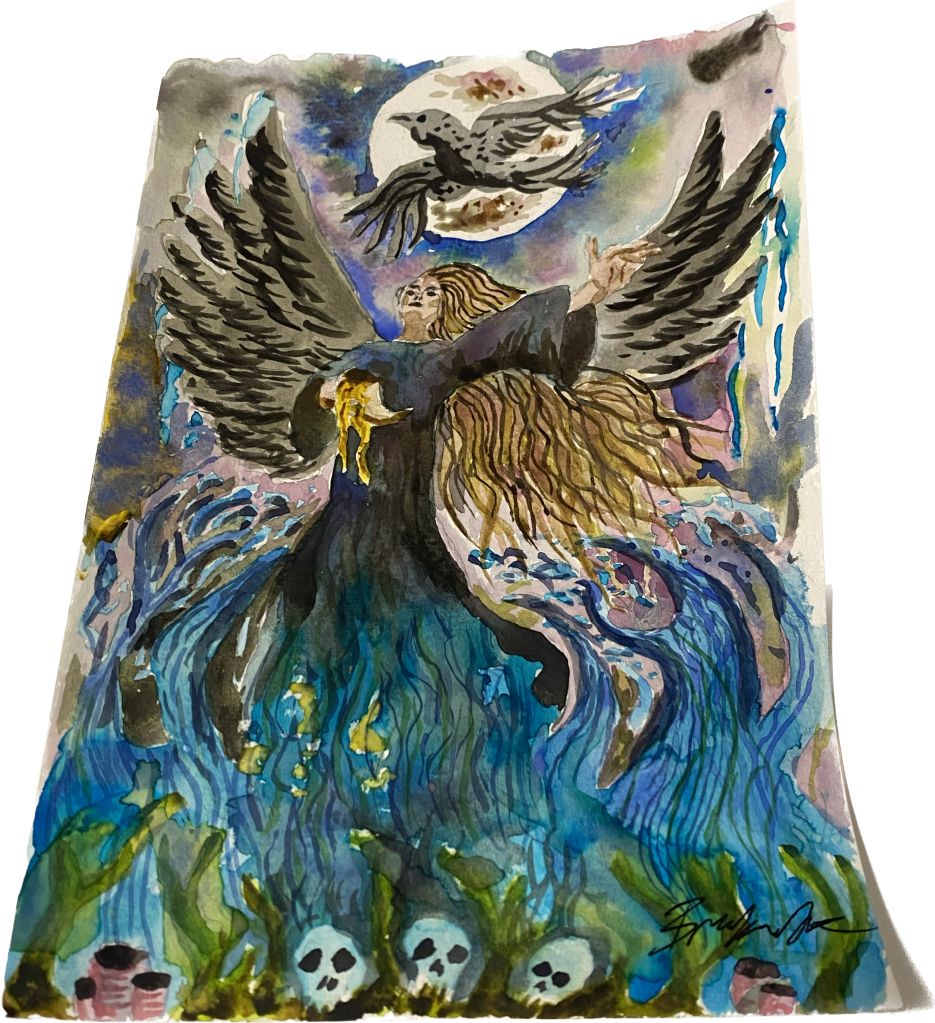
(Brooklyn Frances Arnot, Swim Against The Surging Tide, 2023)

After mourning for Mankind, the Valkyrie perceives the Aesir gods with fuming fury, despising the wickedness of their labor. She defies Odin’s cruel command by choosing to endow the race of men with a sip from the Mead of Poetry. Decisively, she breaks into the Hall of Valhalla, striding amidst her drowsed masters to claim their unworthy gifts. First, she snatches Heimdall’s booming horn, Gjallarhorn, leaving Asgard vulnerable without warning of the foreseeable demise. She will blast upon it to echo across Midgard, mustering her sister Shield-maidens to rebel against the spell of the All-Father and regain their names. Then, she claims Thor’s mighty belt, Megingjord, robbing the god of thunder of his strength to lift his hefty hammer. She will buckle up to bolster her mettle, rousing all her valor to lead every Valkyrie in their last flight to free Mankind. Next, she clutches Odin’s corrupting ring, slithering from his rotten index finger Draupnir to deny him legions of servants who’ll answer his summons. She will wear it to free the race of men from the false promises of wielding great power, rallying them to overthrow the self-proclaimed King of Kings. Lastly, she grips Loki’s magical drink, seizing the Mead of Poetry from the god of mischief to stop his vile consumption and ill counsel. She will taste it to be imbued with the skill to sing and awaken Mankind, bestowing them with instruments to compose a melody.

Promptly, the Nameless Shield-maiden fleets from the Gallery of Gallantry, blaring Gjallarhorn with her left hand as Valkyries gather to propel the doom of their lords. On her hips, she straps Megingjord, doubling her potency to withstand the All-Father’s tempest while soaring through the kingdoms of men. She wields Draupnir with her right hand on her index finger, breaking Odin’s mastery over his dead warriors. However, she clutches the ring until it crushes into pale powder, destroying any temptation to wield such perverting power. Thereafter, she takes a sip from the magical drink as a beating harmony pumps into her veins, rekindling her soul to compose poetry. Suddenly, the Valkyrie remembers her identity, uttering the name of Brunhild, the Battle-maiden who disobeyed Odin and was cursed to eternal slumber as his Sleeping-maiden. Now, Brunhild is reborn to bear the urgent task of gifting Mankind the Mead of Poetry, soaring across Midgard and singing unto them a lost melody. 

Thence, she strides forth to defend the kingdoms of men under the mantle of her tattered wings, standing in defiance of the All-Father as a watchful guardian who shields civilization from the wicked devices of false gods. Brunhild pierces the fog that blots out the sun’s rays, giving way to an inkling of light. Swiftly, her feathers regain color, shimmering akin to incandescent white gems that bloom under the fire’s golden touch. The warmth from her crystal wings reflects on every corner of Midgard, melting away the icy caps that shroud Mankind. She then beholds the kingdoms of men in dismay as they’re consumed by a thunderstorm of spears and shields that smash from one side to the other, giving shape to a ferocious sea. They hurl sticks and stones at a column of barren soil, crumbling the foundation upon which everyone stands. For a flickering flash, she yearns to smite them with Odin’s furious retribution but chooses to reignite their spirits with the tenderness of a mother by composing poetry. Onward, Brunhild reminds Mankind they’re bold warriors, stout builders, and wise sages who endeavored, labored, and crafted civilization. She calls upon the kings of men who erected nations, quelling the emperors who mustered legions. Thus, Brunhild rides through Midgard to sing her melody, for she’s the pillar of every man, a mother who gives birth, a wife who provides love, a teacher who educates, a warrior who protects, and a poet who composes to clothe her lost children with an identity. 

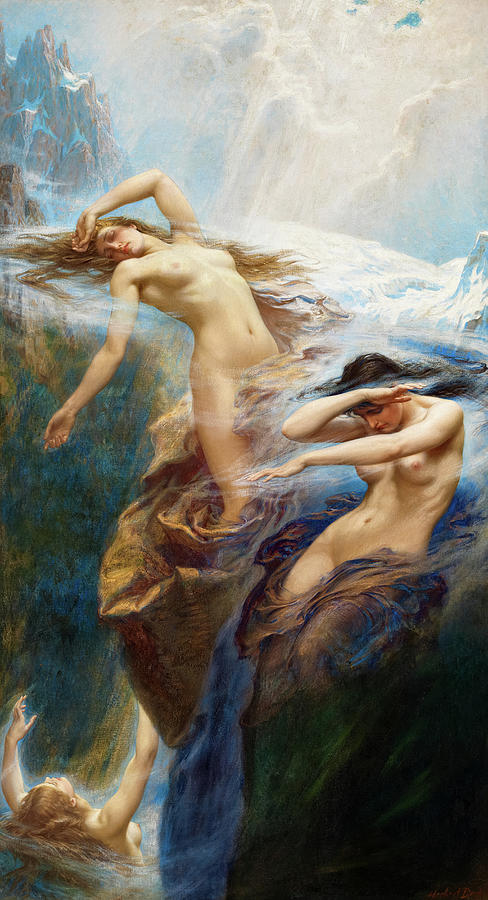
(Herbert James Draper, The Mountain Mists, 1912)

Canto I

Walkyrie Walkyrie Walkyrie

Battle-maiden of Odin

Bound to his whim and will

Chooser of the Slain

Walkyrie Walkyrie Walkyrie

Helm-maiden of Wotan

Armed with spear and shield

Winged Cavalrywoman

Walkyrie Walkyrie Walkyrie

Shield-maiden of the One-Eyed god

Break away from thy bondage

And scorn his cruel command

Walkyrie Walkyrie Walkyrie

Corpse-maiden of the Raven god

Swim against the surging tide

And spread those soaking wings that bound thou to Asgard

Canto II

Walkyrie Walkyrie Walkyrie

Descend from the Gallery of Gallantry

Cast aside thy spear and shield

To be endowed with lyre and melody

Walkyrie Walkyrie Walkyrie

Renounce the rule of Asgard within the Hall of Valhalla

And reach the Realm of Midgard

To awaken the Children of Ask and Embla

Walkyrie Walkyrie Walkyrie

Following in the footsteps of Prometheus

Gift back to Mankind wisdom and knowledge

Akin to stealing the Secret Flame from Zeus

Walkyrie Walkyrie Walkyrie

Thou are burdened with a solemn duty

To rekindle the soul of Mankind with the skill to compose

By seizing from the All-Father the Mead of Poetry

Canto III

Walkyrie Walkyrie Gondul

I bid thee Awake Awake Awake

Upon the blow of mine horn of doom

Take flight and reclaim thy name

Walkyrie Gondul Gondul

Gulp a sip from the Mead of Poetry

Awake Awake Awake Corpse-maiden

 And guide gullible Men away from their delusional vanity

Gondul Gondul Gondul

I gift thee back righteous Identity

Arise Sister Shield-maiden

And be reborn to reclaim thy Destiny

Canto IV

Walkyrie Walkyrie Sigrun

I bid thee Awake Awake Awake

Upon the blow of mine horn of doom

Take flight and reclaim thy name

Walkyrie Sigrun Sigrun

Long have thou meandered meaninglessly

Be armed with the grace and glamour of thy song

Galloping amidst the darkening sky to spread the Mead of Poetry

Sigrun Sigrun Sigrun

Free the Race of Men from Odin’s Tyranny

They’ve slumbered under his rule by worshipping false idols

Sing unto them a honeyed and thundering lullaby

Canto V

Walkyrie Walkyrie Brunhild

I bid thee Awake Awake Awake

Upon the blow of mine horn of doom

Take flight and reclaim thy name

Walkyrie Brunhild Brunhild

A Civilization sculpted by Wise and Knowledgeable Men

Is usurped by a false god who builds legions not nations

Becoming corrupted by Imprudent and Ignorant Men

Brunhild Brunhild Brunhild

The Children of Adam don’t ponder being

Ever since they lost the skill to compose poetry

The Children of Eve don’t irradiate meaning

Canto VI

I bid thee Sing now, Sing, Child of Adam!

For the shadow of doom looms over thou!

Rebel against the spell of the All-Father!

Beckoning forthwith the twilight of the gods! 

I bid thee Sing now, Sing, Child of Eve!

Forsake thine armaments and bear thine instruments!

By answering the blow from mine horn to compose a melody!

Let the Hall of Valhalla crumble upon the booming beat of the drums!

Posted in Short Stories

The Shield-Maiden of Poetry Act II: The Lament of the Valkyrie

By: Bryan Ricardo Marini Quintana

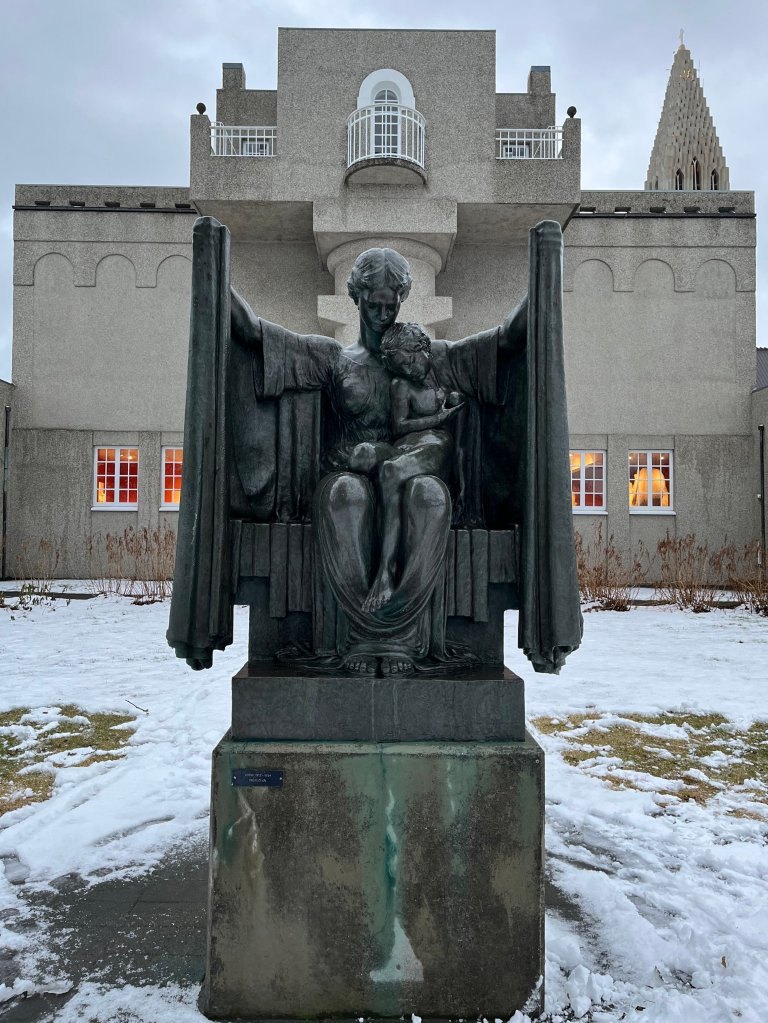
(Einar Jónsson, Protection, 1912-1934)

In the feast’s closing ceremony, giants are paraded in a procession, dragging with trembling feet a gargantuan urn up the hill to Valhalla. Inside resides Odin’s paramount possession, the prized Mead of Poetry. A once formidable adversary of the Aesir gods has been subdued to cold chains, tortured into feeble slaves who thirst with broken lips and harsh throats for a sip from the magical drink that imbues the soul with the skill to sing. While the All-Father mindlessly waddles in his hall, spilling the blessed gift every time he boasts of Asgard’s triumph, the giants gaze miserably as their only remedy is to swallow saliva. Thereafter, Odin’s host becomes drunk with him, as they are intoxicated by delusions of grandeur, misusing the magical drink instead of composing a melody. A wave of uproars echoes in Valhalla when the Aesir gods recite vile verses in mockery, challenging each other to behold who can perform the foulest poetry. Left with a vase nearly empty, Mankind struggles to sustain their identity and attain their destiny. In ridicule, the All-Father laughs at Midgard from his battlements in Asgard, amused by the misery of his subjects who lack the Mead of Poetry to compose a lovely harmony.

Outside the Gallery of Gallantry stands guarding Odin’s terrible legions, a hundred thousand faceless corpses bound to the sway of their master. They were once men of flesh and bone, with a mind, heart, and soul. In their previous lives, they could ponder, feel, and express being. After meeting death valiantly, their flickering flame has been smoked out in the confines of Valhalla, where they lack wisdom, love, and song. Now, they’re obedient soldiers who’re rotting into mindless, heartless, and soulless cadavers whose thoughts and actions are dictated by the All-Father. Their hunger and thirst are quenched with an endless stream of pork from the boar Saehrimnir and wine from the goat Heidrun, confining them to an unconscious and gratified state who have forgotten their role as men.

Under the guidance of false gods such as Odin, Mankind has been persuaded by fear and desire in their search for meaning. They’ve played with all manner of perversion, confounding themselves with power and pleasure. Subsequently, the Einherjar trudge through in their eternal slumber when they’re called upon to reclaim their identity, losing all wisdom and knowledge to forge a destiny. The civilization erected by wise and vigorous men has fallen into decay due to the imprudence and frailty of the youth, who’ve succumbed to the guise of a benevolent Lord of Gifts, revealing himself to be the treacherous Lord of Deceit.  In Midgard, Mankind has become twisted into a new breed of Miserable, Impartial, and Tyrannical Men who pull the masses from one end of the rope to the other as they stumble upon the precipice that leads to their damnation.

The All-Father’s winged warriors oversee this age of watchful peace, spreading their splendor and horror to Mankind. They descend from Asgard to quell revolts that oppose their master, brewing petty quarrels between the kings of men to keep their domains divided. From these endless squabbles, Odin fills his hall in Valhalla with brother slaying brother in an undying cycle, as Valkyries claim their souls to quench his hungry belly that scours the face of the earth for fresh meat to satiate his stockpile. Without a spirit to compose a song, they heed the Lord of the Slain’s command, pitting kingdom against kingdom, host against host, king against king, and man against man. Now, the civilization of their forefathers is lost in the wells of time and space, leaving them bereft of composing a melody as they cling to misery, impartiality, and tyranny to give their lives a semblance of meaning.

The once honorable duty of bearing the wings of a Shield-maiden as custodians of harmony is now a sentence of oblivious servitude. With their purpose twisted, Valkyries soar over the realms of men as ill omens of foreboding doom, beckoning that judgment day looms closely. Their lustrous shields and spears have corroded and bloodied in their service. Those glittering wings with a tint of frosty snow that soar in the sky’s clouded sea have lost their pure color. These have darkened into pale grey, whose feathers blot out the golden touch of the sun, leaving only the moon’s misty glow as a token of dismay. 

From the battlements of Asgard, a flock of Valkyries flies by to Valhalla, witnessing the feast of the Aesir gods, who abuse their foes, trick their allies, and misuse the blessed gift of the Nine Worlds. A single-winged warrior is repulsed by the sight of Odin’s host sloppily spilling the Mead of Poetry. After seeing the madness of her master, she breaks away from her flight and sails against the tide of her sister Shield-maidens. Defiantly, she soars through the black fumes that sprout from the All-Father’s forges, endlessly fashioning armaments for the coming of Ragnarok. Above the blinding smoke, the Valkyrie beholds the foul craft of the Aesir gods, longing to remember her name and confront her fate. The Nameless Shield-maiden hides amidst the dark clouds with the paleness of her wings, popping her head out to gaze at Midgard’s tragedy.

There, she weeps inconsolably, casting away her shield and spear after contemplating her role as a pawn of Asgard’s cruelty. She witnesses the self-destructive nature of Mankind, who become architects of their own suffering. The Valkyrie is overcome with a feeling of powerlessness, pondering in defeat that the realms of men will never awake to realize they’ve been chained under Odin’s command. Suddenly, she gleams as an incandescent beacon of luminous white, thinking she could compose a melody to rouse them from this strife. However, her spirit falters upon mere mention, doubting her skill to sing an alluring harmony. She beholds the Gallery of Gallantry again in agony, mourning the final droplets spoiled on the floor from the Mead of Poetry. Thereafter, the Nameless Shield-maiden is bolstered to defy the rule of the All-Father with a renewed purpose to compose a melody, lamenting the decline of Mankind’s civilization.

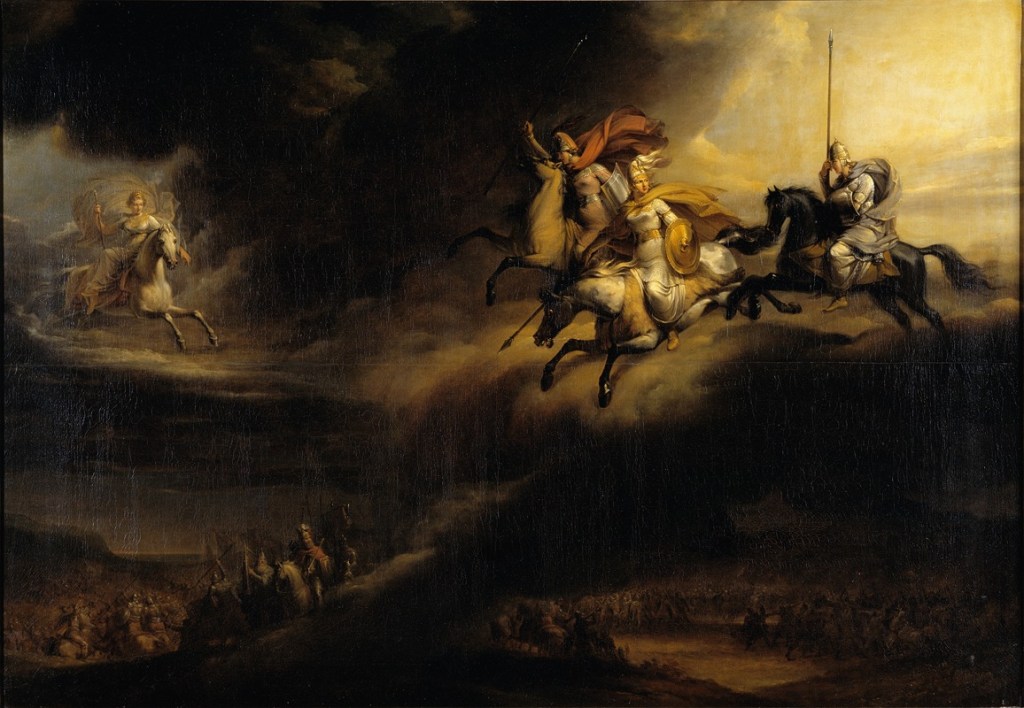
(Johan Gustaf Sandberg, Valkyries Riding into Battle)

Canto I

Where have the Bold Warriors sailed? 

Where are their deeds? 

Where have the Stout Builders sailed? 

Where are their labors?

Where have the Wise Sages sailed?

Where are their stories?

Where has the Race of Men sailed? 

Where are their souls?

Alas the age of heroes has come to pass

Alas for the wisdom and knowledge of their forefathers

They’ve played with power and pleasure

They’ve succumbed to fear and desire

Where have the Children of Adam sailed? 

Where is their sense of meaning? 

Where have the Children of Eve sailed? 

Where is their sense of being? 

Canto II

Above in Asgard, the Aesir gods have seized the Mead of Poetry

Below in Midgard, Mankind cannot compose a melody

In disdain, a child tosses the skill to sing from his caring forefather

In mockery, the child erects a monument in reverence to the cruel All-Father 

Who will quench his search for destiny to find meaning?

None but the Aesir gods will bathe him with a false identity of being

Canto III

Among the lost Children of Jehovah, I mourn for Miserable Men 

They’ve refused to carry the burden of responsibility

By foolishly attempting to escape destiny

In a struggle of futility to thwart the certainty of mortality

In Midgard, Miserable Men renounce pondering life’s streams

Opting to slumber for eternity rather than awake to the horror of consciousness 

They’re washed away by the currents into an abyss of meaninglessness 

Canto IV

Among the lost Children of Adam, I grief for Impartial Men 

They’ve disregarded the skill safeguarded in ancient institutions

By judging, sentencing, and burning the civilization of their forefathers

In a circus trial by the mob who slander the ability to differentiate virtues and vices 

In Midgard, Impartial Men please the crowd by losing their individuality 

Ceding to repeat unquestionably the slogans of a mob mentality

They lose all sense of morality to accommodate everyone in society 

Canto V

Among the lost Children of Eve, I weep for Tyrannical Men 

They’ve twisted individuals into oblivious followers

By claiming to possess every remedy for their troubles

In a world of demagogues, the state decrees their thoughts and actions 

In Midgard, Tyrannical Men impose their flawed ideology 

Devising monstrous stratagems to be worshiped as a deity

They sink civilization with them when their devices endeavor fruitlessly 

Posted in Short Stories

The Shield-Maiden of Poetry Act I: The Discord of the All-Father

By: Bryan Ricardo Marini Quintana

(Edvard Isto, The Attack, 1899)

Atop the World Tree of Yggdrasil, the Aesir gods gather for a banquet in their stronghold of Asgard, singing praises to the All-Father for his absolute dominion over the Nine Realms. In the kitchens, the once graceful race of elves, smothered from their beauty, now prepares a feast. They’ve been twisted into sickly creatures who’re horrid to behold, heeding their new masters. In the forges, the once mighty race of dwarves, stripped of their vigor, now craft armaments. They’ve also been warped into cowardly creatures who’re miserable to behold, obeying their new lords. First, the sickly children of Alfheim offer tribute with a three-course meal, serving giants’ eyes, ears, and tongues. Viciously, the Aesir gods devour their chief enemies as they discard the paltry chunks, feeding Odin’s wolves, Geri and Freki. Next, the cowardly children of Svartalfheim also offer tribute, with the marrow bones of giants twisted into monstrous chalices of pale ivory. From these drips the blood of Ymir’s offspring as the Aesir gods become drunk with their juice. They bibulously toast to the All-Father’s eternal health while quenched in cherry wine to swallow their madness whole.

Deep within the Gallery of Gallantry, rests Odin over his throne in Valhalla, awaiting the return of his ravens to fetch tidings from a Witch who mocked his command and has eluded his sight. Upon his right hand, he grips Gugnir, a splendid spear that strikes fear into any foe that defies him. On his left hand, he wears Draupnir, a cunning ring that drips eight golden circlets every ninth night, with the index finger rotting to ashen dust due to incessant use. These are gifted to the kings of men, whipping them to his servitude. Hastily, Huginn and Muninn, the All-Father’s Thought and Memory, soar above a bent sea of legions sworn to serve Odin, to repose on his right and left shoulders. The ragged ravens bring ill tidings to the Lord of the Slain, pestering in their insolence about their failure to find the Prophetess who defied Odin by reciting the doom that looms over the Aesir gods in Asgard. Above all, the All-Father fears the fruition of her prophecy and relentlessly labors to thwart this destiny that will end his domain with the coming of Ragnarok.

Every night, Odin is haunted by the verses of the Witch that foretell Mankind’s awakening. Upon the blaring of Gjallarhorn, the sky bursts asunder as the icy fumes that shroud Midgard melt away to the flaring flame of the sun that glares through sleepwalking corpses. This will be followed by the singing of Valkyries that descend unto kingdoms to break the spell of Draupnir that has bound kings to the All-Father’s grip. By rekindling their spirits, Mankind awakens to challenge the cruel dominion of the Aesir gods that robbed them of their being, enflaming the World Tree of Yggdrasil. Ultimately, Asgard meets its demise, with the grand designs of the One-Eyed god to be King of Kings crumbling into frail sand, allowing the world to be reborn anew under the dominion of men.

For their fruitless task, Odin tosses foul meat to his starving pets, who gobble sumptuously at crumbs intended as punishment from their master. Thereupon emerges Loki Laufeyson, ever the rabble-rouser, who stirs delusions in the ears of the All-Father. He approaches Odin as a trustworthy advisor, discreetly counseling suspicion over his lordship’s ravens. In a maddening accusation, the god of mischief feeds the All-Father with persistent paranoia, finding amusement in rousing the temper of Odin by accusing Huginn and Muninn, his Thought and Memory, of committing treason. Loki apprehends the ravens with conspiracy charges, denouncing their scheme to dethrone the All-Father with spells from the Prophetess. Immediately, Huginn and Muninn plead with Odin, begging for his benevolent mercy while he beholds them with piercing anger. He questions their allegiance to him, cursing his Thought and Memory for this treachery. Both ravens attempt to reason with him but realize they’ve already been condemned to perish. Swiftly, the god of mischief bows before the All-Father and feigns to submit himself as a lowly and loyal servant by swearing reassurances of his faithfulness. Thereafter, he turns back to face Huginn and Muninn, slandering them as conniving spies, with a grin that extends from cheek to cheek.

In a fit of fury, Odin sentences his Thought and Memory to death and summons the god of thunder to execute them. Thereupon rumbles Thor Odinson, ever the hammer of the gods, who serves at the behest of his father’s bidding. On his hip, he fastens Megingjord, a belt that doubles the god of thunder’s strength. There he suspends Mjolnir, enacting the iron will of Asgard with lightning bolts from his mallet. Resolutely, Thor tightens his girdle and grips his hammer, summoning a thunderstorm that scorches the ravens.

Throughout the Nine Realms, the god of thunder scours below the fumes that sprout from the furnaces of Valhalla to remind the race of men who reign over their lives. He descends when the Aesir gods flog him to crush rebellions that contest the All-Father, also becoming a slave to their whims. In Midgard, Thor collects tribute from the kings of men who fall on their knees in marvel and dismay over the Aesir gods. He receives gifts and sacrifices from them in reverence to the Lord of the Slain. In perpetuity, the god of thunder visits the Norns, a coven of sorceresses who engrave on a tablet the fate of the Aesir gods and Mankind. They’re held captive in the catacombs of the underworld, where Thor tortures them in Mimir’s Well. Here, Odin once forfeited an eye in exchange for mastering magical power, and now his son drowns the Norns in the same fountain of wisdom. Each day, they’re forced to drink every droplet smothered unto their lips as the god of thunder smites them with a stroke of his mallet. After their unending torment, Thor grieves his fate as the instrument of Asgard’s tyranny, forcing them to recite prophetic verses that will give the All-Father an answer. Nevertheless, the cruel devices of Odin falter as the Norns cackle maniacally at the self-proclaimed One-Eyed god who cannot escape his foreboding destiny, reciting the same doom that haunts him in mockery.

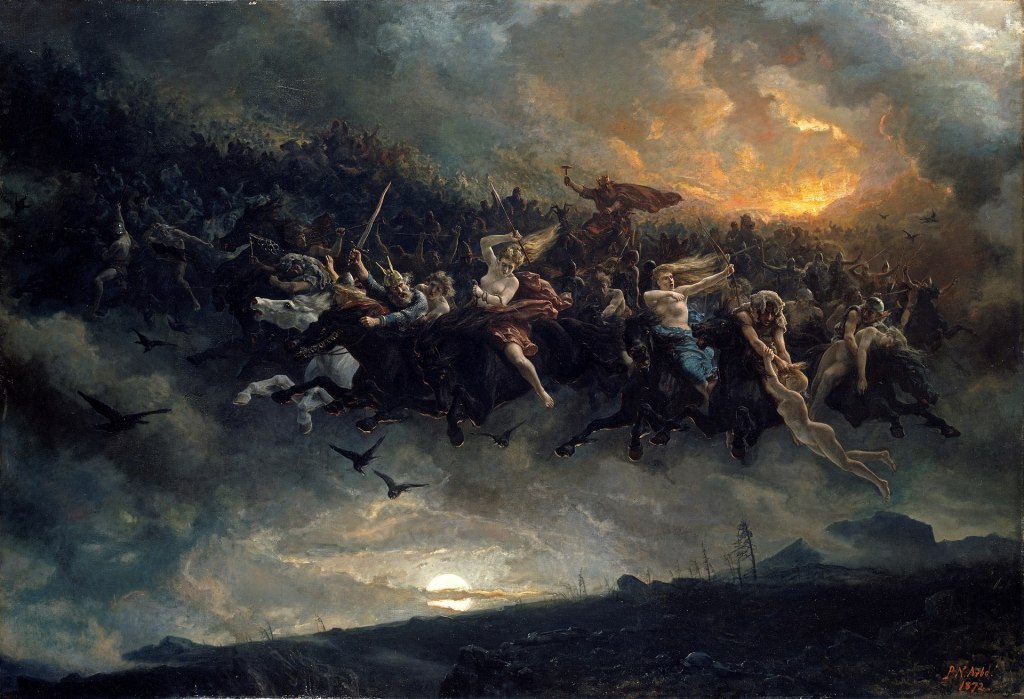
(Peter Nicolai Arbo, The Wild Hunt of Odin, 1872)

Canto I

One eye in sacrifice for the wisdom of foresight from the Norns

This is the price the Aesir god will pay

One eye in exchange for the skill of magic from the Runes

This is the price the Aesir god will pay

Nine days the One-Eyed god hanged

To acquire knowledge of the Realms

Nine nights the One-Eyed god dangled

To acquire knowledge of the Cosmos

Scouring relentlessly to know the fate of every object that could challenge him

Searching ceaselessly to know the doom of every insect that could oppose him

Canto II

Two items the dwarves crafted for him

A Ring called Draupnir

To bend the minds of Men to his whim

Two items the dwarves fashioned for him

A Spear named Gugnir

To succumb the spirits of Men to his will

For his son, Thor, they gifted him the Hammer Mjolnir 

Fighting off the Frost Giants from Jotunheim

For his guardian, Heimdall, they gifted him the Horn Gjallarhorn

Warning of the Fire Giants from Muspelheim

Canto III

In perpetuity, every ninth night, eight rings drip from Draupnir

Bestowing the Race of Men with glimmering golden crowns

To corrupt their souls with delusions of grandeur

Within the Gallery of Gallantry, where the Lord of the Slain resides

Until the doom of the gods, The Discord of the All-Father disturbed

By twisting Just Kings into Cruel Emperors

Until the twilight of the gods, The Melody of the Valkyries will be quelled

Within the Hall of Valhalla, where the All-Father resides

In seclusion, Odin ponders with dread and envy the verses of the Norns, foretelling the fate of the Aesir gods. Desperately, the All-Father endeavors incessantly to thwart his inevitable destiny. Upon his throne, Odin is burdened by divinations that threaten his grand schemes, summoning a host of subservient shields and spears to defend the walls of Asgard. Shield-maidens and dead warriors are assembled at his right and left hands. The booming beat of their blissful hearts has been silenced, becoming obedient Einherjar and Valkyries. In their slumber, they’re powerless to rebel against the spell of the All-Father, who binds them to defend Valhalla and deprives them of composing melodies. This host is led by Heimdall, the warden of Bifrost, who hoists everywhere on his girdle Gjallarhorn, ready to blast the horn over the rainbow bridge, warning the Aesir gods of their demise while calling to arms Einherjar and Valkyries to fight.

Thereafter, Loki serves Odin’s Thought and Memory on a silver platter as the All-Father devours himself. When witnessing this folly, Thor sheds a tear, grasping that for all the mettle of Megingjord and Mjolnir, he’s incapable of mending his father’s sanity. Under Odin’s sway, this triumvirate holds dominion over Mankind in Midgard, leaving Yggdrasil’s roots to wither and its leaves to fade in an obsessive hunt to elude the Prophetess’ prophetic visions. When his designs waver, he becomes haunted by the verses of the Norns, binding the Nine Realms to the same fate of shadow and flame that awaits the Aesir gods in Asgard. Upon his right hand is seated the god of thunder, Thor Odinson, a brute who pitilessly crushes the foes of his father. On his left hand is seated the god of mischief, Loki Laufeyson, a serpent who utters poisonous counsel to incite the wrath of the All-Father. From the Hall of Valhalla, this triumvirate conjures the miseries and diseases of Midgard, steadily losing their grip over the race of men at the tightening of the fist, beckoning forth the twilight of the gods.

Posted in Short Stories

A Civilized Beast

By: Bryan Ricardo Marini Quintana

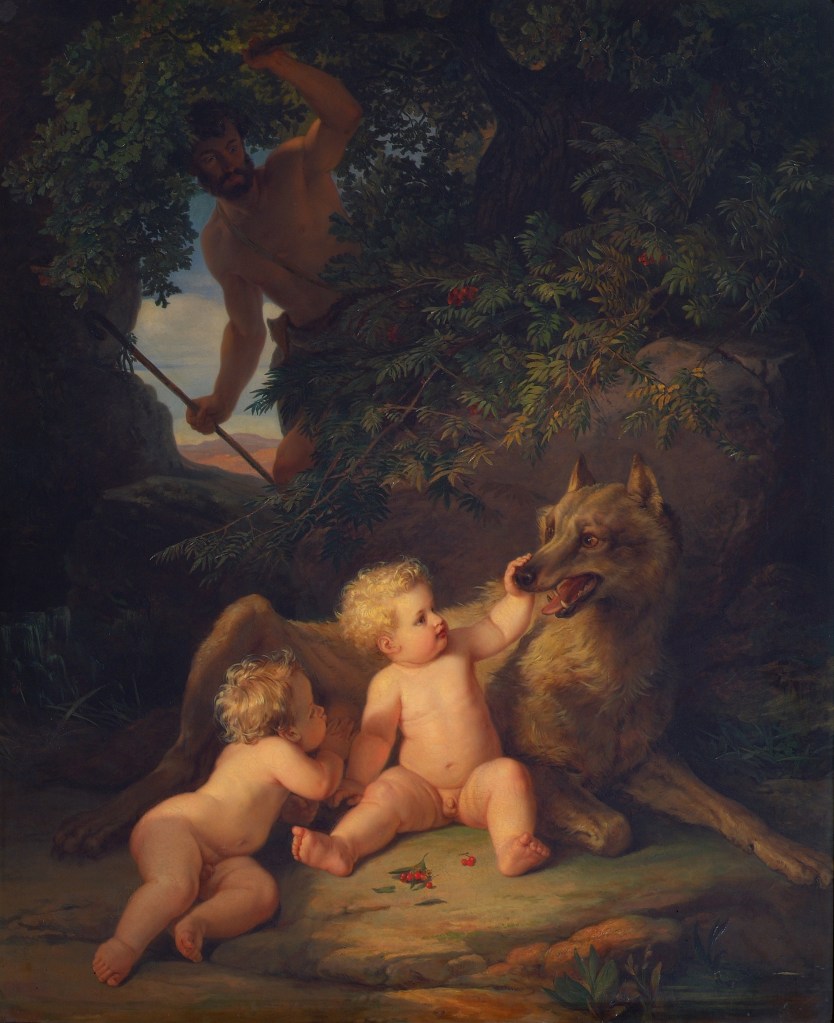
(Joseph Binder, Romulus and Remus, 1850)


“At the edge of the civilized farm, a bloodthirsty beast prowled the wild woods, the untamed wolf.”

Long ago, the Shepherd’s proverb taught Wolfe of the dangers posed by the barbaric nature of his kind. After swearing loyalty to his new master, he was bestowed with the gift of consciousness. From thereon, Wolfe showed no remorse for the pack of wolves that hunted nearby. To keep his conscious state, Wolfe had to fulfill his duties and remain within the borders of the civilized farm. When he left the wilderness behind, Wolfe chose to have an identity by embracing a sheltered life within civilization, thankful that the Shepherd had granted him a name.

Before the wolf was tamed, the Shepherd wandered away from civilization in defiance of nature, facing the depths of human fear and desire. Although tempted to relish boundless freedom, he withstood nature’s melody, abiding by the laws of men as he traversed into the wilderness. Amidst this rabid forest, a pack of wolves reigned unopposed over this lawless land. Here, they were at the top of the food chain, with all other beasts lying below at the mercy of their behest. Driven by jealousy of the wolf’s grip over these woods, the Shepherd sought to defile their status in nature. The infuriating inability to submit them by force urged him to build a farm. There, he retreated into the confines of civilization, where the Shepherd hid in fear of the wolf’s wrath.

Afterward, his sheer ambition of expanding the borders of men’s laws compelled the Shepherd back into the wild to save beasts from themselves. A righteous purpose motivated him to yield nature to his will, fighting for the survival of his consciousness. Once the wolves were deposed from their power, he would proclaim himself as the dominant species of nature, and civilization would fear no rivals, with animals learning the decrees of men. On a blessed night, as the full moon rose, the pack of wolves thundered from the forest to confront a civilized man and devour their prey. However, nature betrayed them as a fog emerged to shade the pale light, leaving the wolves weakened and exposed. At the tipping point of the confrontation, the Shepherd shot the pack’s leader and turned the tide. In a frenzy of terror, the wolves scattered, retreating into the darkness of their caves. Amidst the chaos, a cub was left behind, with the Shepherd claiming the beast as his prize to civilize nature. He took him back to the farm, where the wolf was given a name, taught manners, trained how to communicate, and drilled to fulfill tasks. Any sign of nature’s lawlessness within him was stripped away, and he became Wolfe, an animal destined to fulfill the Shepherd’s command to spread civilization.

Inside the farm, various animals assumed different responsibilities to maintain the institution of their society, serving at the bidding of their new master. The herd’s servitude was rewarded with the commodity of life in their home. Here, conscious animals accomplished their errands and, in exchange, relished their identity and safety. Among them, Wolfe found meaning in his duty by guiding the flock of sheep and protecting them beyond the civilized farm. Outside, the pack of wolves lay lurking in the woods while Wolfe beheld them from afar as wild beasts who were incapable of questioning or reasoning about their very existence.

Whilst leading a flock of sheep into the wilderness, Wolfe confronted the dangers posed by the forest. A constant temptation to turn berserk haunted him as he traversed through nature. Then, Wolfe stood at the top of a hill, staring down at the pack of wolves that prowled nearby. In these tense moments, he was tested as he gazed fearfully at his kind, remembering his natural state. However, Wolfe would always recall how he was rescued by the Shepherd and gifted a consciousness that allowed him to relish his identity. These memories made Wolfe come to terms with who he was, constantly reminding himself of the purpose given by his old master. If he wanted to keep his name, Wolfe must continue obeying him by guiding and defending the vulnerable flock of sheep. This way, Wolfe accomplished his chores and served his purpose to the civilized farm, fending off those wild beasts. Although Wolfe’s choice reassured him of his place amongst civilization, he had consequently disassociated himself from the pack of wolves. 

On the way back, as Wolfe entered the confines of the civilized farm again, he glanced back at these rabid beasts, wondering if he truly belonged here or there. The tamed wolf became tortured by his consciousness and discovered his morality, realizing that these conflicted with each other as he questioned his duty to civilization. Wolfe was puzzled by his identity, asking himself if he was ever meant to survive amidst the natural habitat of the oblivious wilderness or if he was destined to evolve and become civilized. Further on, Wolfe pondered whether he was ordained to enlighten his kind or fated to keep them at bay, remaining dormant in their barbaric state. Decisively, Wolfe turned away from their tempting glances, returning to the civilized farm but feeling conflicted about the decision to preserve those borders between conscious animals and wild beasts. From the safety of civilization, Wolfe heard the spellbinding howl from the pack of wolves, calling him back into those dark woods. This sparked curiosity within the tamed wolf, who wondered how these beasts could feel companionship with him if they lacked a conscious state. Every day, Wolfe traveled back and forth, leading the flock of sheep to the wilderness and out of those depths into civilization as he grew doubtful of his very name.

Suddenly, temptation struck on a cursed night when the full moon rose, and the pack of wolves thundered from the forest. Wolfe immediately became entranced by the rabid beasts’ preying eyes, grizzled hair, sharp claws, and salivating mouths. They lashed themselves toward the flock of sheep, fighting ferociously against Wolfe, who valiantly protected them to safeguard his kind. Swiftly, Wolfe clawed and drooled over the ground while the pack of wolves drew ever closer, with the dormant wilderness awakening to be set free. When they attacked, Wolfe passed out. Upon awakening, he gained consciousness, only to realize that around him lay a slaughtered mountain of beasts. He gazed at their gnawed carcasses that had been viciously devoured as Wolfe remained frozen by his reaction. In that instant, he was terrified of the carnage he had caused, questioning his identity. Immediately, he looked at the sheep to be comforted by them of his civilized manners, but they turned away in horror. The flock fled to the civilized farm to tell their Shepherd what travesty had occurred. Subsequently, Wolfe shifted between his conscious and wild state to decide what to do with them, fearful of his master’s harsh sentence. He reasoned that the flock of sheep observed him with their proud eyes and refused to speak with a beast. When Wolfe realized that these animals had unjustly judged him after saving them, he caved into his natural state. Here, the beast made an irrational action that the animal still lingering inside him attempted to justify as rational, eating the flock of sheep to prevent his master from uncovering the truth. In an act of desperation, Wolfe launched himself at his former kind and feasted lavishly on their flesh, succumbing to the dusk’s ghostly glow.

After the massacre, Wolfe lay petrified over his foul deeds, burdened by the consciousness of a civilized animal and yet consumed by the wilderness of an untamed beast. Then, Wolfe pondered whether he should confront the Shepherd and face his judgment. However, he feared his master’s whip, knowing he would be found guilty and ostracized from his home. Otherwise, Wolfe understood that if he were banished from his master’s farm, he would forget himself. Furthermore, he would lose his driving purpose for life and his bed at the sanctuary. Yet, Wolfe was unwilling to face the weight of his crimes, knowing he would pay a hefty price. Consequently, Wolfe contemplated that his only option was to hide in the woods, but he had no pack to hunt with anymore. If he chose to go back into the wild, Wolfe would forget who he was. The tamed wolf didn’t want these options, and he knew that either path doomed him to lose his life’s meaning. In a final act of reason, Wolfe consumed himself instead of submitting to his master’s punishment or nature’s lawlessness. Here, Wolfe opted to die young, preserving his conscious state rather than living the rest of his life alone and succumbing to old age. This fate terrified Wolfe, who grasped that he would roam the wilderness without reasoning his existence. Instead, Wolfe chose to perish savagely by his piercing fangs, preferring to leave this world while he still could cling to his consciousness for a little longer. Therefore, Wolfe greeted his mortal end with grace, believing it was honorable to die in his youth with a divine purpose to uphold, a stream of memories to evoke, and a unique name to own. 

“Alas, the wolf could not be tamed, as nature reclaimed him in his rabid state whilst he devoured himself with table manners, keeping a shred of civilized dignity at the very end.”

Posted in Short Stories

A Child’s Play

By: Bryan Ricardo Marini Quintana

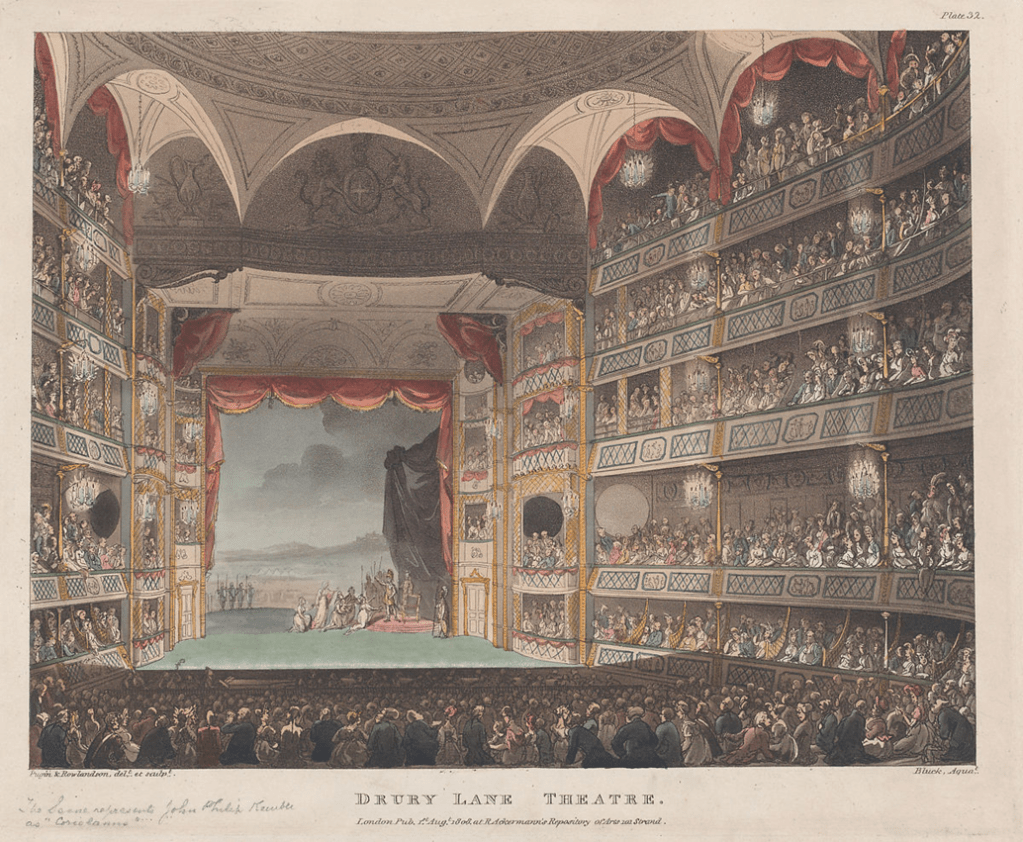
(Thomas Rowlandson, Drury Lane Theatre, 1808)

Act 1: A Choice

Late at night, passing by colorless streets, a dazzling theater illuminates the pale ambiance. Deciding to halt for a glance, I’m frightened by an imposing shadow that creeps over me, constraining any movement. It’s the adult I’ve become, rashly yelling: “Stay outside and carry on with routine.” Tempted to turn around, a frail silhouette dashes over, willing to loosen any motion. It’s the child I’ve lost, gently whispering: “Go inside and try something new.” A flicker of impulsiveness sways me, eager to soothe a monotonous mind. “I don’t have time,” reaffirms an impatient adult. “What about me?” longs an abandoned child. Will I empower the adult and neglect the child? In an act of recklessness, instinct kicks, as I’m drawn to purchase a ticket, seeking liberation in A Child’s Play. Thereafter, a silhouette’s frail hand grasps upon a shadow’s rugged fingers that cling unto my flesh, guiding both to the entrance. Once inside, a blinding light drives away both shades, leaving me to make a choice. Should I leave or stay? Close by, murmuring adults apathetically diminish the play, discouraging any enthusiasm. However, far-off, giggling children eagerly boost the play, driving away any pessimism. Steadily, I take a seat, choosing to embrace A Child’s Play and longing for a return to what I’ve lost.

Act 2: Where I Belong

Inside, a hall welcomes my arrival while the stage neglects me. Upon seeing my adult drama, a somber hall illuminates the way to a seat reserved especially for me, whereas a joyful stage dims away and closes its curtains when noticing my lack of childish fun. Reality settles in, for I’m a part of an audience, not the show. Behind, there are grim adults ready to spectate. In front, there are cheerful kids ready to act. While those who live confined to reality are relegated to meager seats in a hall, those who live beyond in dreams are uplifted by rich lights on a stage. In the audience, there are no outstanding personalities. Everyone stuck in a seat hides behind a fancy suit or dress that befits a norm. Ashamed of my true self, I sell a personality that complies with society’s expectations. However, on that stage, there’s a colorful wardrobe of unique personalities. Each actor wears what abides to their taste. Proudly, they rebel against society’s constraining guidelines. While spectators have chosen to dim away from the spotlight, actors embrace it. Suddenly, lights fade in the hall to neglect my adult drama while a stage brightens to empower A Child’s Play.

Act 3: A World Of Imagination

Once the play begins, my spectrum of reality breaks away, freeing an imprisoned mind. Brewing with life, the stage is transformed into magical domains and far-reaching corners of space. These are inhabited by children who polish the stage with performances that transform them into whimsical characters, displaying their unique personalities. They’ve come to embrace a playful spirit, showing no shame, fear, or guilt in what the audience perceives. From heads to toes, children dress in silly clothes with outrageous amounts of makeup and ridiculous hairstyles. Regardless, they keep on enjoying their performances carefree. Atop, the stage accepts you, letting true feelings be expressed without judgment. This is a freedom only actors relish, one a kid exuberates. Agonizingly, I’m stuck in an adult’s world of spectators while they are free to act in A Child’s Play.

Act 4: A World Lacking Color

Amidst the intermission, my spectrum of imagination fades away, returning to a confined seat that promptly recalls reality. Dwindling with life, the hall remains dull. Down here, rows of seats don’t undergo any transformation since there’s no time to wander in places I’ll never reach. A hall encompassed by deprived adults doesn’t display uniqueness within anyone. Instead, a monstrous spirit feeds from fear, shame, and guilt that suppresses them into hiding from outsiders. Amongst spectators, a sea of identical clothes and faces hides behind a facade. Each one is careful, avoiding any display of emotions. I follow them by subduing my feelings because if I’m exposed, their rejection will follow. This is a suffocation only spectators suffer; one every adult quells. I was once an actor, but now I’ve grown into a spectator, and time holds me back from ever returning to A Child’s Play.

Act 5: My Awakening

In a grim moment of self-defeat, I come to terms with a stage far from my reach while a childhood spirit of memories attempts to refresh my mind, body, and soul. This cheerful aroma drives away the dismal fume. Although I’ve descended from that stage, these children remind me of what dawning an actor’s performance was like. In that play, they pass on what the audience lost. Suddenly, a child’s curiosity is awakened within me. A wondrous sense of adventure comes back, amazing me with every trivial discovery and replacing indifference. Thereafter, a child’s joy is sparked. Through giggling kids, miseries wash away. Afterward, a child’s innocence initiates. In an act of carelessness, feelings of guilt rinse away. However, I’m the only one rediscovering wonderment, laughter, and purity. Realizing none have joined in the act, I begin to hide again with judging eyes that sharply criticize me. Regardless, I’ve come too far to give in, proceeding to neglect at least for once the adult and empower the child. Now, I gather up a child’s bravery to complete my transformation. Consequently, fear hides away, with childhood fully awakened in triumph over adulthood. Nevertheless, a childish spirit reaches the audience, with frowns turned to smiles, shame to liberation, and reality to imagination. A somber hall is awakened by spectators, who, even though they’ve left the spotlight, now ecstatically remember what it was like to be up there. Finally, A Child’s Play is embraced by spectators who relish the freedom an actor embodies, refreshing their memories of curiosity, joy, innocence, and bravery.

Act 6: A Show Must End

Enlightened, I savor this last moment with my rediscovered inner child, knowing the play won’t last forever. Unwavering eyes gaze upon the stage, recalling a concealed bubble that an actor fills up with dreams of a hopeful future. Inside were written scenes and a character’s guideline to follow through. Abruptly, the bubble burst upon facing reality, leaving characters stranded without any sense of direction. Outside the theater, away from a stage’s spotlight, nothing was scripted, allowing despair to take over while I sought to uncover my true character. Whilst lingering in thoughts of a lost youth, A Child’s Play ended, witnessing an actor’s culmination. Performers were stripped of characters and lines, leaving an exposed nakedness of personalities barely defined. Then, each child bowed before the audience, subjugating to reality. They’ve given away their frivolous characters’ curiosity, joy, innocence, and bravery. Soon after, a harsh transition occurs, relegating everyone to a role backstage. In there, each one will interact behind the scenes, close enough to the action yet far away from the thrill of the main act. A time will pass when they’ll mature, undertaking a journey to find their true selves and replace me. Meanwhile, I get up and give my seat to the next person who passes from the backstage to assume a role in the audience. My time here is up, but at least I’ve been reminded of what it was like to be a child. Once more, a silhouette’s frail and smooth hands grasp my wrinkled ones. Now, it guides me back to the hallway where I made a fateful decision. Here, I chose to embrace my inner child. However, behind lies my imposing shadow, yearning to stay. Desperately, it grabs my hand, begging me to return. Although tempted to relish that feeling of being young again, I’m dissuaded, opting to give another the chance to experience it. Decisively, I turn away the older shade as it peels off from any hold on my body. Whatever energy was left in me has been sucked away by the play and a fleeting shadow that decays. Passing through the hallway, my mind eases, accepting there’s no return to childhood, yet thankful those days ever happened. Where once night reigned when I came in, now day deposed it with my exit. Upon these final moments, a feeble silhouette leaps upwards to a dazzling light, and fire surges through me again as I return to my purest form to the heavens above, in the nakedness of an actor who is received by an eternal embrace of A Child’s Play.